Free SEO competitor analysis template: 8-section guide
65% of software deals are now competitive (Crayon, 2024). Here's a free SEO competitor analysis template — 8 sections — and the 1-hour workflow to fill it.

Search "SEO competitor analysis template" and you'll find two kinds of results. The first is a roundup of fifteen tools, none of which is a template. The second is a spreadsheet gated behind an email form — and when you finally download it, half the cells are blank headers with no guidance on what to put in them.
Neither tells you the part that actually matters: what goes in each cell, and how to fill the whole thing without a $30K tool or a dedicated analyst. That's the gap this piece fills. Below is the full eight-section template — copy it, no form — plus the one-hour workflow a small team can run to keep it current.
It matters more than it used to. 65% of sales opportunities for the average software company are now competitive (Crayon, 2024), and organic search still drives roughly 53% of all website traffic (BrightEdge). If you can't see what's ranking against you, you're optimizing in the dark.
Key takeaways
- 65% of software deals are competitive (Crayon, 2024) and ~53% of web traffic is organic (BrightEdge) — search visibility is a competitive battleground, not a vanity metric.
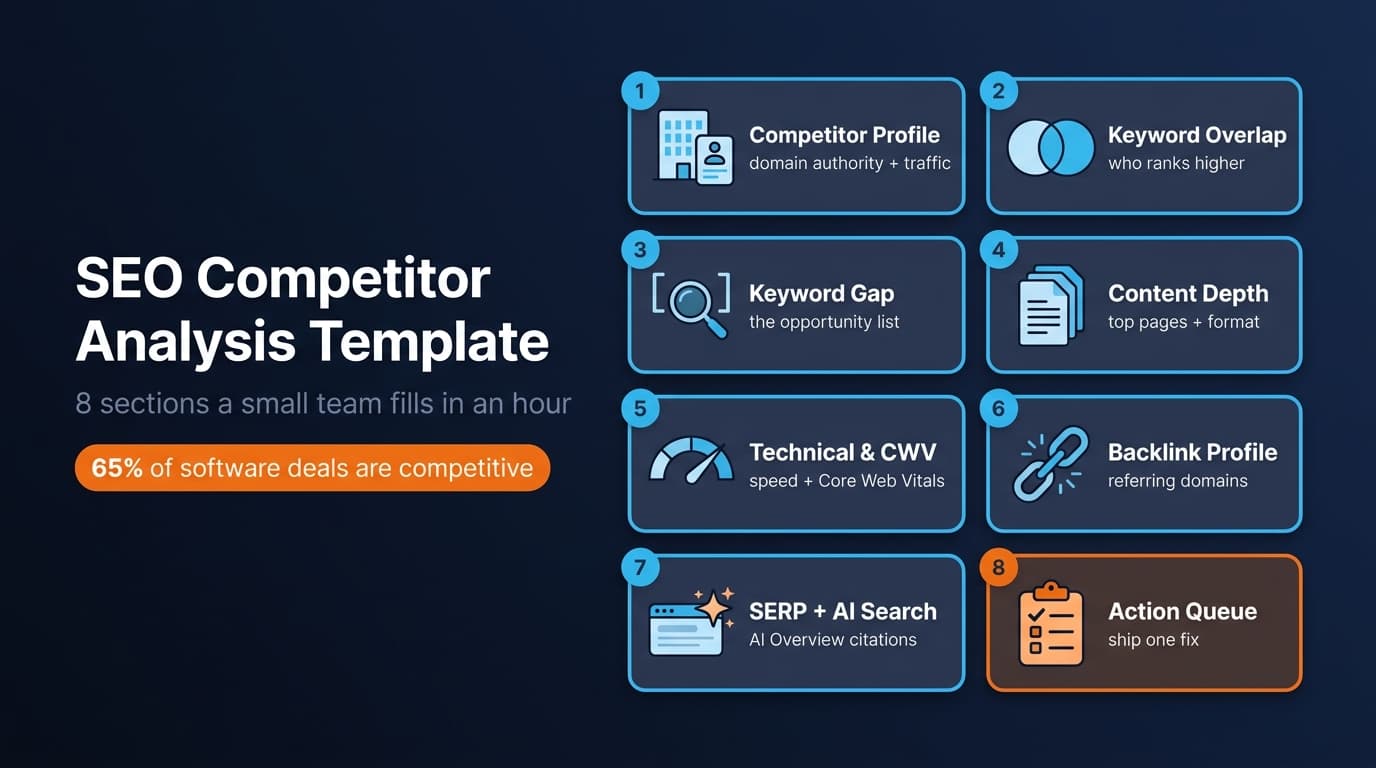
- The template has 8 sections: competitor profile, keyword overlap, keyword gap, content depth, technical health, backlinks, SERP + AI-search presence, and the action queue.
- The 2026 difference: with ~58% of US Google searches ending without a click (SparkToro, 2024), analysis now has to cover who gets cited in AI Overviews — not just who ranks #1.
- The workflow: pick 3 competitors → pull their data → score the gaps → ship one action. About an hour, run weekly.
What is an SEO competitor analysis template?
An SEO competitor analysis template is a structured framework for benchmarking competitors across the things that decide search visibility: keyword overlap, keyword gaps, content depth, technical health, backlinks, and — new in 2026 — presence in AI-generated answers. It replaces the ad-hoc version most teams run, where someone opens ten browser tabs on a Friday and calls the result a strategy.
The structure is the whole point. 65% of software deals are competitive (Crayon, 2024), and a template forces you to look at the same dimensions for every competitor, so you can actually compare them. Without that consistency, you get impressions, not intelligence.

Who's it for? Mostly the person doing all the marketing at a small company, or the agency owner who needs a defensible analysis for a pitch — people who understand SEO but don't have a research team. The template gives them the rigor of a CI analyst without the headcount. The data sources below are deliberately ones a small team can reach for free, with a clear note on where paid tools earn their keep.
What 8 sections does an SEO competitor analysis template need?
A useful template covers eight sections, in order, from "who are they" to "what do we do Monday." Skip any of them and you get a half-picture — usually a keyword dump with no action attached. Roughly 30,800 SaaS companies exist globally, with about 1,500 new ones launching every month (Ascendix, 2025), so the goal isn't to boil the ocean. It's to track three to five real competitors well.
Here's the template. Copy it into a sheet and you've got your tabs.
| # | Section | What to capture | Where to get it (free) |
|---|---|---|---|
| 1 | Competitor profile | Domain, domain rating/authority, estimated monthly organic traffic, category | Free tier of Ahrefs/Semrush, Similarweb |
| 2 | Keyword overlap | Terms you both rank for, and who ranks higher | Search Console + a keyword-gap tool |
| 3 | Keyword gap | Terms they rank for that you don't (the opportunity list) | Keyword-gap report; manual SERP checks |
| 4 | Content depth | Top pages, word count, format, update frequency | Their /blog, sitemap, "site:" search |
| 5 | Technical & Core Web Vitals | Mobile speed, INP/LCP, indexable pages, schema | PageSpeed Insights, free crawl |
| 6 | Backlink profile | Referring domains, top linking pages, link velocity | Free backlink checkers |
| 7 | SERP + AI-search presence | SERP features they own; AI Overview / ChatGPT citations | Manual SERP + AI-assistant checks |
| 8 | Action queue | One prioritized action per finding, with owner + status | You — this is the deliverable |
The first seven sections are inputs. Section eight is the only one that changes anything. Most templates you'll download stop at section six and present a wall of data with no "so what" — which is exactly why they get filled in once and abandoned.
Sivon's competitor agent populates these eight sections automatically against your Brand Blueprint — pulling each competitor's traffic, keywords, content, and SERP footprint into one consistent schema, so you start from a filled template instead of a blank one.
How do you fill the template in under an hour?
The fill is five steps, about ten minutes each: pick three competitors, pull their keyword data, map the gap, check AI-search presence, and write one action. The constraint is deliberate. 56% of SMB marketers have an hour or less per day for marketing in total (Constant Contact, 2024), so a template that needs a full afternoon never gets run twice.
Step by step:
- Pick 3 real competitors (10 min). Not the category leaders — the ones who actually show up in your deals and your SERPs. Cross-check your closed-lost notes against who ranks for your three most important keywords.
- Pull keyword data (10 min). Export each competitor's top organic keywords from a free tool tier, plus your own from Search Console. This feeds sections 2 and 3.
- Map the gap (15 min). Find the terms they rank for and you don't. This is section 3, and it's where the wins are.
- Check AI-search presence (10 min). Ask ChatGPT and Google "best [your category] for [your ICP]" and note who gets named. This is the new section 7.
- Write one action (5 min). Pick the single highest-value gap and put it in section 8 with an owner. One. Not twelve.
The discipline is picking one action, not building a backlog you'll never clear. A template that produces one shipped change a week beats a 40-tab audit that produces a feeling of productivity and nothing else. If you want the deeper, prompt-by-prompt version of this, our AI-assisted competitor analysis workflow walks through the exact ChatGPT prompts for each step.
How do you do a keyword gap analysis (the highest-ROI section)?
A keyword gap analysis finds the terms your competitors rank for and you don't — the demand you're leaving on the table. It's the single highest-ROI section of the template because, unlike rebuilding your technical stack, acting on a gap is just writing one page against a query you already know converts for someone else.
The method is simple. Take your top three competitors, export their ranking keywords, remove the terms you already rank for, and what's left is your gap list. Sort by a rough mix of volume and how commercial the intent is, and the top of that list is your content roadmap for the next quarter — already validated by the fact that a competitor is ranking for it.
One caution from running this on our own category: the biggest gap list is usually padded with branded and irrelevant terms the tool counts as "missing." Before you treat the list as a roadmap, strip out competitor brand names, careers pages, and anything off your ICP. The real gap is smaller and far more useful than the raw export suggests.
The 2026 layer: tracking competitors in AI search
Here's what most templates miss entirely: in 2026, ranking #1 isn't the same as being seen. About 58% of US Google searches now end without a click to the open web (SparkToro, 2024), increasingly because an AI Overview answered the question on the page. So section 7 has to track who gets cited in AI answers, not just who holds the blue-link top spot.
The check takes ten minutes. Ask ChatGPT, Google, and Perplexity your three highest-intent questions — "best [category] for [ICP]," "[your product] vs [competitor]," "how to [core job]" — and record which competitors get named and linked. That citation list is its own competitive ranking, and it often looks nothing like the organic SERP.
The non-obvious finding when we did this for our own category: a couple of competitors with weaker domains were getting cited more than stronger ones, purely because they answered the question in the first 60 words of a page. AI systems reward a clean, extractable answer over raw authority. That's a gap you can close in an afternoon — restructure your top page to lead with the answer. If you want the full method, see our guide to getting cited in AI search and the specifics of ranking in ChatGPT.
Free template vs. a CI tool: which should you use?
A free template is enough right up until you're tracking five or more competitors weekly — past that, the manual refill cost quietly exceeds a paid tool's subscription. The honest breakeven is whoever's filling it: as long as it's a 1-hour task for one person, stay manual. Once it needs a half-day a week, you're paying for the tool in labor anyway.

It's worth being clear-eyed about price tiers, because most roundups aren't. Enterprise CI platforms like Klue and Crayon assume a dedicated analyst and run $30K+ a year — overkill below a real CI function. The middle is where small teams actually live: under-$500/mo tools that automate the data pull without the enterprise contract. We break down what's worth paying at each tier in our comparison of CI tools for small businesses, plus the specific Klue alternatives and Crayon alternatives that fit a team under 50. The template gets you 80% of the value at zero seat cost; a tool buys back the time, not the insight.
Turning the template into a weekly loop
A competitor analysis run once is a deck. Run weekly, it's an early-warning system — and that difference is the entire return on the exercise. The teams that win with this don't have a better template than you. They just refill the same one every Friday, so they catch a competitor's pricing change in week one instead of in a lost deal three months later.
The cost of treating it as a project shows up downstream. 79% of CI teams arm sales with battle cards, but only 26% say reps use them as much as they'd like (Crayon, 2024) — almost always because the card is stale, written once and never refreshed. A live template feeds a live battle card. Once your analysis is current, turning it into something sales will actually open is the next step, and our battle card template is the long-form guide to that handoff.
Sivon keeps the loop running for you — the competitor agent refills all eight sections continuously against your Brand Blueprint and surfaces only what changed that's worth acting on, so the weekly review is a five-minute read instead of an hour of data entry.
Frequently asked questions
What should an SEO competitor analysis template include?
Eight sections: competitor profile, keyword overlap, keyword gap, content depth, technical/Core Web Vitals, backlink profile, SERP and AI-search presence, and an action queue. The first seven are inputs; the action queue is the deliverable. With ~53% of web traffic coming from organic search (BrightEdge), each section maps to a real lever on visibility.
How do you find a competitor's keywords?
Export their top organic keywords from a free tier of Ahrefs, Semrush, or Similarweb, then run a gap report against your own Search Console data. What they rank for and you don't is your opportunity list. The method scales: 65% of software deals are competitive (Crayon, 2024), so the keywords they win are the demand you're missing.
How often should you run an SEO competitor analysis?
Weekly for your three core competitors; quarterly for a deeper positioning refresh. Pricing pages, new content, and AI-citation patterns shift too fast for a once-a-year cadence. The point of keeping the template to a 1-hour fill is that 56% of SMB marketers have an hour or less a day for marketing (Constant Contact, 2024) — weekly only works if it's fast.
What is a keyword gap analysis?
It's the process of finding keywords your competitors rank for that you don't, by subtracting your ranking terms from theirs. It's the highest-ROI section of the template because each gap is a pre-validated content opportunity — a competitor is already proving the query converts. Strip out branded and off-ICP terms first, or the list overstates the real gap.
Do free SEO competitor analysis templates work without paid tools?
Yes, for three to five competitors. Search Console, PageSpeed Insights, free tool tiers, and manual SERP plus AI-assistant checks cover the eight sections at zero cost. The limit is scale: past five competitors tracked weekly, the manual refill time exceeds an under-$500/mo tool, which is the point to consider paying for a CI platform.
So what now?
SEO competitor analysis in 2026 didn't get harder — the cost of skipping it went up. With 65% of software deals competitive, 53% of traffic riding on organic search, and the majority of searches now ending in a zero-click AI answer, "we'll benchmark the competition next quarter" is how you find out you've been losing deals you never saw.
Copy the eight-section template above, pick three real competitors, and fill it once this week. You'll have a gap list, an AI-citation ranking, and one action worth shipping inside an hour. Then run it again next Friday — because the version that compounds isn't the prettiest template, it's the one that's current.
If you'd rather not refill it by hand, Sivon's competitor agent runs the whole loop — profile, keywords, gap, content, technical, backlinks, AI-search presence, and the action queue — against your Brand Blueprint, so the analysis is grounded in your actual product and ICP instead of a generic framework. Either way, build the system once. The next time someone asks "how do we beat them on search?" — the answer's already in front of you, refreshed last Friday.