Best AI search visibility tools 2026: tracking vs management
ChatGPT's share of generative-AI traffic slid from 77% to 57% in a year. Compare the best AI search visibility tools of 2026 — tracking vs management.

Search used to hand you a list you could rank on. AI search hands you a paragraph that either names your brand or doesn't — and a competitor sitting in the sentence where you should be. There's no position seven to climb in a ChatGPT answer. You're cited, or you're invisible. That gap is the whole reason AI search visibility tools exist.
These tools track whether ChatGPT, Perplexity, and Google's AI Overviews mention you, how often you're the cited source, and how that compares to rivals. The surface is too large to guess at: Google's AI Overviews alone reach about 1.5 billion monthly users (Similarweb, 2026). This guide ranks the best AI search visibility tools in 2026 — and splits them into the two jobs that actually matter: tracking and management.
Key takeaways
- The category split in two. Tracking tools tell you whether you're cited; management tools help you fix it. Most teams overpay for depth they can't act on yet.
- Single-engine tracking is a trap. ChatGPT's share of generative-AI traffic slid from 77% to 57% in about a year (Similarweb, 2026) as Gemini, Claude, and Perplexity climbed. Watch the engines you're growing into.
- Start cheap, then scale. Entry trackers run ~$29–59/mo; the field averages ~$337/mo (Analyze, 2026). Begin with a free audit before any subscription.
- A tool that only detects leaves the hard part to you. The fix — publishing citable, structured content — happens in a separate workflow most trackers don't touch.
What are the best AI search visibility tools in 2026?
The best AI search visibility tools in 2026 sort by what you need to do, not by a single headline feature. Investors clearly think the category is permanent: more than $300M in venture funding flowed into AI-visibility startups between mid-2025 and early 2026 (Surmado, 2026), and Profound alone raised $96M at a $1B valuation in February 2026 (SiliconANGLE, 2026). Here's the field, split by whether the tool tracks, manages, or does both.

| Tool | Type | Best for | Engines covered | Entry price (2026)* |
|---|---|---|---|---|
| Otterly.ai | Tracking | Budget first look | ChatGPT, Perplexity, AIO, Gemini | ~$29/mo |
| Knowatoa | Tracking | Free audit + clear tiers | 7 platforms | Free audit · ~$59/mo |
| Peec AI | Management | Mid-market analytics + recommendations | ChatGPT, Perplexity, AIO (+add-ons) | ~€89/mo |
| Scrunch AI | Management | Multi-engine + SOC 2 procurement | 4+ engines | ~$250/mo |
| Profound | Management | Enterprise source analysis | 10+ platforms | Enterprise (~$330–5,000+/mo) |
| Sivon | Track + fix | Small teams that want to act | ChatGPT + AI surfaces | Audit + in-platform |
*Entry pricing per vendor sites and 2026 roundups; verify current rates before buying.
For the full field — including AEO-specific platforms and brand-monitoring tools beyond this list — our best AI visibility tools guide maps the whole category end to end. This page zooms in on the visibility-tracking-and-management lane specifically.
AI search visibility tracking tools: are you even there?
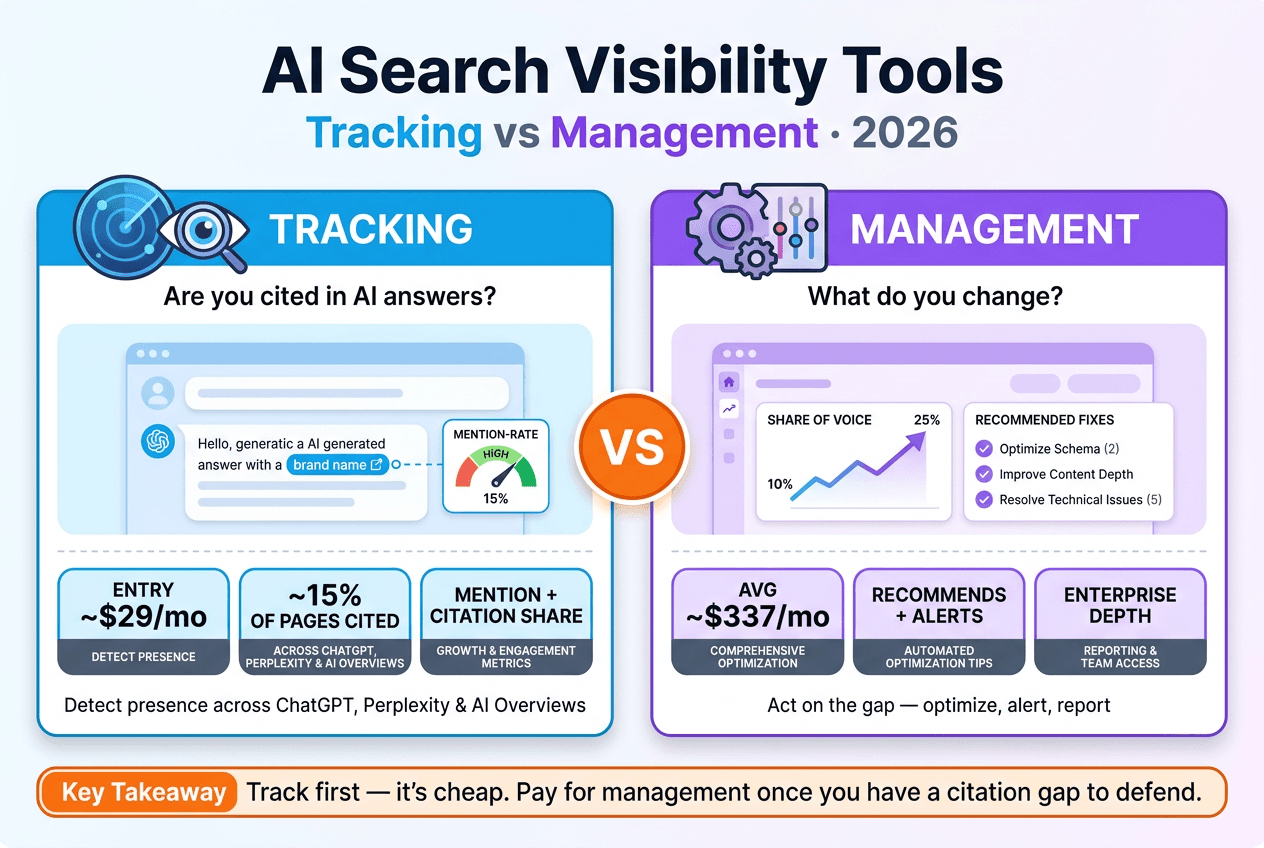
AI search visibility tracking tools answer one blunt question — are you cited, and where? They sample a set of prompts on a schedule, then report mention rate, citation share, and share of voice. The reason a single number isn't enough: AI engines cite only a sliver of what they read. ChatGPT names roughly 15% of the pages it retrieves for an answer (Zyppy, 2025), so presence is a probability you measure across many prompts, not a rank you check once.
This is the cheapest tier to be wrong in, which is exactly why most teams should start here. Otterly.ai punches above its ~$29/mo entry price with multi-platform coverage and a built-in audit. Knowatoa is the clearest on-ramp in the category: a free initial audit with no signup, then tidy tiers near $59/mo that watch seven engines at once. Both replace "rank" with the metrics that actually move — mention rate and citation share — without a procurement conversation.
The non-negotiable discipline is that you track a set of prompts, not one. A tracker that reports a single tidy "AI visibility score" is flattening a system that gives different answers to the same intent. Ask "best X tool" and "X tools for small teams" and the cited sources barely overlap. If a tool can't group prompts into clusters and trend share of voice across them, it's selling theater, not measurement. For the multi-engine version of this — trackers built to watch every LLM surface at once — see our guide to LLM SEO tools.
AI search visibility management tools: what do you change?
AI search visibility management tools start where tracking stops. Once you know you're under-cited, the question becomes what do I change? — and that's a different product. The price reflects it: the field averages about $337/mo, and enterprise source-analysis platforms run far higher (Analyze, 2026). You're paying for prioritization and recommendations, not just detection.
Peec AI sits in the mid-market near €89/mo, going past raw tracking to recommend content changes and surface sentiment — and it's growing fast on that promise. Scrunch AI (~$250/mo) covers multiple engines with SOC 2 Type II for buyers who need procurement cover. Profound is the depth reference point: it breaks down how AI engines assemble an answer and which sources they pull from, increasingly reporting on how AI agents — not just humans — encounter your brand. That depth is why it lands enterprise budgets, and why it's overkill for a six-person team.
The pattern is hard to miss: tracking is cheap, management is where the bill climbs. So the buying mistake isn't picking the wrong vendor — it's buying management depth before you've confirmed, with a tracker, that you have a gap worth managing. And much of that "management" is a craft you can run yourself: structuring pages to be the cited answer is its own discipline, broken down in our guide to answer engine optimization tools.
How do you choose between AI search visibility tools?
Choose by who you are and what you'll do with the data — not by engine count. A solo marketer confirming a gap, an agency tracking many brands, and an enterprise defending a category each need a different tool, and the worst outcome is a $300/mo subscription nobody acts on. Start with the cheapest question — are we cited at all? — and only climb when the answer is no and you have content capacity to respond.

A simple decision tree:
- Just need to know if you're invisible? Run a free audit (Knowatoa), then a budget tracker (Otterly) for 90 days.
- Tracking many clients or brands? Buy a multi-brand management platform with share-of-voice reporting.
- Defending a category with a procurement team? Pay for enterprise source analysis (Profound, Scrunch) and SOC 2.
- A small team that has to fix what it finds, fast? Pick a tool that closes the loop from finding to published page.
Our read: running Sivon's own AI Visibility audit (
geo_audit_agent) against a sample brand, we asked the same buying question across three engines on the same day. Perplexity cited the brand; Google's AI Overview for the near-identical query didn't mention it at all; ChatGPT named a competitor first. Same brand, same intent, three different verdicts. Any tool that collapses that into one "visibility score" is hiding the variance that should drive your content plan. The honest unit is share of voice, per engine, across a prompt set.
That cross-engine spread is also why the foundational work matters more than any dashboard. Before you compare trackers, the structural fundamentals — clean content, answer-first formatting, crawlable pages — decide whether you're citable at all. Our guide to AI search optimization covers that groundwork; the tools on this page only tell you whether it's paying off.
Where does Sivon fit?
Most AI search visibility tools stop at detection. They show you you're under-cited and, at best, hand you a brief — then the dashboard's job is done and yours begins. Sivon sits one stage further on purpose. Its AI Visibility audit scores how citable your brand is across AI surfaces, Pulse tracks how that score and your mentions move over time, and the content engines draft the structured, quotable pages that earn the citation — written against your Brand Blueprint, so the fix sounds like you and not like every other listicle.
The distinction worth naming before you buy is detection versus correction. A tracker shows you where you stand; the fixing happens somewhere else, in a workflow you have to wire up yourself. Sivon won't out-track Profound on enterprise prompt-set depth, and it won't replace a dedicated multi-brand platform for a 50-client agency. It's built for the team that needs the finding and the fix in one place, without buying a tracker and a content stack and a person to connect them.
Whichever tool you choose, pair it with a publishing motion. A monitoring subscription with nothing behind it to act on is a precise way to watch yourself lose. If you'd rather see your AI standing and act on it in one system, run Sivon's AI Visibility audit — and once the fix ships, Pulse watches the trend so you know it worked.
Frequently asked questions
What are AI search visibility tools?
AI search visibility tools track whether AI engines — ChatGPT, Perplexity, Google AI Overviews — mention your brand in their answers, how often you're the cited source, and how that compares to competitors. They replace the rank-tracking model of classic SEO, because AI answers have no ranked list to climb. Some only track; others also recommend and apply fixes.
What's the difference between tracking and management tools?
Tracking tools answer one question: are you cited, and where? They report mention rate, citation share, and share of voice across a set of prompts. Management tools go further — they prioritize gaps, recommend content changes, and in a few cases publish the fix. Tracking tells you the score; management helps you change it.
What are the best free AI search visibility tools?
Start with a free or one-time audit before subscribing. Knowatoa offers a free AI-visibility audit with no signup or card, and has run 5,000+ of them (Knowatoa, 2026). A first audit answers the only early question that matters — are we cited in AI answers at all? — without committing to a monthly tracker.
How much do AI search visibility tools cost in 2026?
Entry plans run roughly $29–$250/mo, with enterprise tiers from $499 to several thousand. The average across 30+ AI search monitoring tools is about $337/mo (Analyze, 2026). Budget trackers (Otterly ~$29, Knowatoa ~$59) cover the first 90 days; pay for management depth only once you have a citation gap to defend.
Do I need a separate tool for each AI engine?
No. Most AI search visibility tools cover ChatGPT, Perplexity, and Google AI Overviews together, with Gemini and Claude standard or as add-ons. Single-engine tracking is the real risk: ChatGPT's share of generative-AI traffic slid from about 77% to 57% in a year (Similarweb, 2026), so a ChatGPT-only view goes blind to the engines growing fastest.
The bottom line
AI search has no rank to chase — only a paragraph that names you or doesn't. The best AI search visibility tools in 2026 measure that the honest way: citation share, mention rate, and share of voice across a prompt set and across engines, because ChatGPT's lead is sliding and a single-surface view goes dark on the rest. Split the category before you spend. Tracking tools answer are we there? cheaply; management tools answer what do we change? at a premium.
Do the cheap things first — run a free audit, then a budget tracker for 90 days — and climb to management depth only once you've confirmed a gap and have the content capacity to close it. The brands winning the AI answer aren't watching the dashboard hardest; they're shipping the citable content the model wants to quote, then tracking whether it landed. For the wider field, our AI visibility tools guide ranks every category. When you're ready to find the gap and fix it in one place, run Sivon's AI Visibility audit.