ChatGPT SEO tracking tools in 2026: what to actually track
ChatGPT cites only ~15% of the pages it reads, yet drives 80%+ of AI referral traffic. The best ChatGPT SEO tracking tools in 2026 — and what to track.

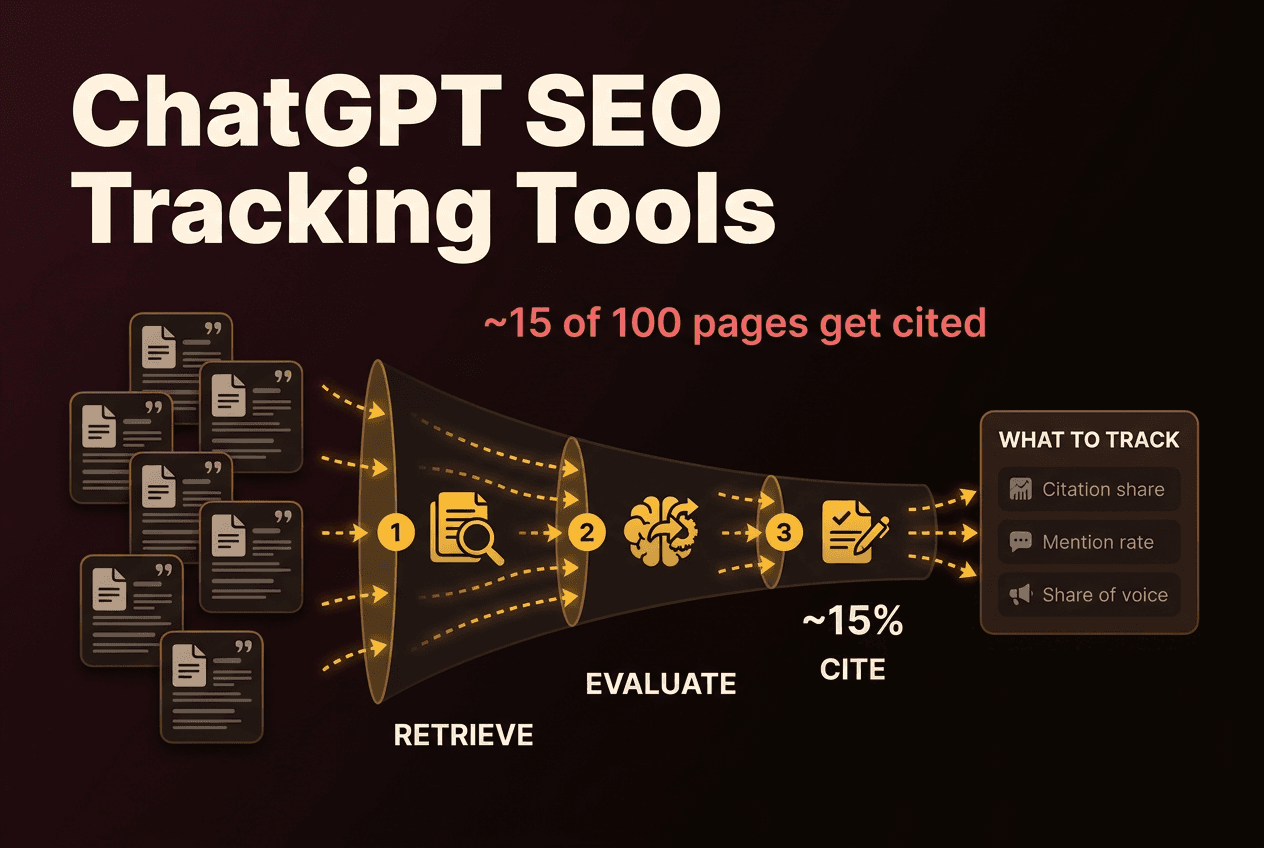
You can track your Google rank to the decimal. Ask "what's my rank in ChatGPT?" and the honest answer is: there isn't one. There's a sentence in a chat reply that either names your brand or doesn't — and a competitor's name sitting where yours should be. The rank-tracker reflex doesn't transfer when the result is a generated paragraph.
That's the confusion most "ChatGPT SEO" tools quietly trade on. They promise a position to climb, but ChatGPT doesn't rank pages — it cites a handful of them. And the surface is too big to ignore: ChatGPT reached 900 million weekly active users in February 2026, more than double a year earlier (TechCrunch, 2026). This guide covers how ChatGPT actually surfaces sources, what to measure instead of a phantom "rank," and the best ChatGPT SEO tracking tools in 2026.
Key takeaways
- ChatGPT has no rank. It retrieves pages, evaluates them, and cites only about 15% of what it reads (Zyppy, 2025) — so a tool reporting a single "ChatGPT position" is selling a fiction. Track citation share, mention rate, and prompt-level share of voice instead.
- It's still the biggest surface: 900M weekly active users (TechCrunch, 2026) and 80%+ of AI referral traffic to top domains (Similarweb, 2025) — but its share is sliding as Gemini and Claude rise, so single-engine tracking is a trap.
- ChatGPT Search runs on Bing's index. If Bing can't crawl and index you, ChatGPT can't cite you — a free prerequisite no tracker fixes for you.
- Start with a one-time audit (~free) to confirm the gap before subscribing. Budget trackers run
$29–59/mo; save enterprise depth ($499/mo) for when you have a category to defend.
How does ChatGPT decide which sources to cite?
ChatGPT cites only about 15% of the pages it retrieves for an answer — the other 85% are read, evaluated, and discarded without ever appearing (Zyppy, 2025). It doesn't rank pages on a list. ChatGPT Search pulls candidate sources for a query, its model weighs them, and it quotes or paraphrases the few it trusts. The "SERP" is a paragraph, and you're either in it or you're not.
Two things follow from that, and most listicles skip both. First, there's a plumbing dependency: ChatGPT Search and Copilot draw heavily on Bing's index, not Google's. If your pages are missing from Bing Webmaster Tools, no tracker can save you — you're invisible to ChatGPT at the source. Verifying and submitting your sitemap to Bing is the free, structural first step before any subscription. Second, "rank tracking" is the wrong mental model entirely.
So what does a citation funnel look like? Of every batch of pages ChatGPT pulls in to build an answer, only a sliver gets named. The chart below makes the ratio concrete — and explains why the metric that matters isn't a position but a probability.
If you want the on-page work behind earning that citation, our guide to how to rank in ChatGPT covers the levers. This piece is about the tools that tell you whether the work is paying off.
So what do you actually track?
Since there's no #1, you track presence, not position — and the strongest signal of where you stand is buried in the page itself: the first 30% of a cited page accounts for 44.2% of LLM citations, the middle 31.1%, and the last 24.7% (Zyppy, 2025). A good ChatGPT SEO tool replaces "rank" with four metrics: mention rate (how often you're named), citation share (how often you're the linked source), share of voice (your slice versus competitors), and sentiment (cited well, or cited as the cautionary tale?).
The non-negotiable part is that you track a set of prompts, not one. Here's what changed how we think about this.
Our read: running Sivon's own AI Visibility audit against a sample brand, we asked ChatGPT the "same" question two ways — "best X tool" and "X tools for small teams." The cited sources barely overlapped. Tracking a single prompt is tracking noise; the honest unit is a prompt set, scored as share of voice across repeated runs. Any tool that reports one tidy "ChatGPT rank" is flattening a system that gives different answers to the same intent.
That's the practical test for a tool. Does it let you group prompts into clusters, run them on a schedule, and report citation share over time — or does it hand you a single number and a green arrow? The first is measurement; the second is theater.
ChatGPT is the biggest AI surface — but not the only one
ChatGPT drove more than 80% of AI referral traffic to the top 1,000 domains in 2025, on the back of AI referrals growing 357% year over year (Similarweb, 2025). It is, by a wide margin, the surface to track first. But "first" isn't "only" — and the trend line under the headline is where teams get caught.
ChatGPT's share of generative-AI web traffic has been sliding as rivals climb: from roughly 77% in early 2025 to about 57% by March 2026, while Gemini jumped from 6% to 25% and Claude from under 2% to 6% (Similarweb, 2026). A ChatGPT-only tracker covers the biggest slice today and goes dark on the slice that's growing fastest. The fix isn't to stop tracking ChatGPT — it's to pick a tool strong on ChatGPT that also watches the engines you're growing into.
This is also the argument for not buying ChatGPT tracking in isolation. For the multi-engine picture, our guide to LLM SEO tools breaks down trackers built to watch every AI surface at once, and the full field of AI visibility tools maps the category end to end. If you're comparing trackers head-on, our AI search visibility tools guide splits the field into tracking versus management.
What are the best ChatGPT SEO tools in 2026?
The best ChatGPT SEO tools in 2026 sort by who you are — a solo team confirming a gap, an agency tracking many brands, or an enterprise that needs source-level depth — not by a single "rank" feature. Investors are betting the category is permanent: Profound raised $96M at a $1B valuation in February 2026, with 700+ enterprises on board (SiliconANGLE, 2026). Here's the comparison, then a short read on each.

| Tool | Best for | What it tracks | Other engines | Entry price (2026)* |
|---|---|---|---|---|
| SE Ranking | Teams already on a rank tracker | Mentions, citations, "not cited" gaps | AI Overviews, AI Mode, Gemini, Perplexity | Add-on |
| AIclicks | Prompt-set share of voice | Prompt-level mentions, citations, SOV | Perplexity, Gemini, AIO, Claude | Mid-tier |
| Rankshift | Agencies, multi-brand | Mentions, citations across clients | All major LLMs | Mid-tier |
| xSeek | ChatGPT-first + crawler logs | Citations, GPTBot crawl activity | ChatGPT + others | Specialist |
| Peec AI | Mid-market with recommendations | Visibility, sentiment + actions | Perplexity, Gemini, AIO | ~€89/mo |
| Profound | Enterprise source analysis | How answers are built, source mix | Many | ~$499/mo |
| Otterly / Knowatoa | Budget first look | Mentions, citations | 6 platforms | ~$29–59/mo |
| Sivon | Small teams that want to act | Audit + Pulse, then ships the fix | ChatGPT + AI surfaces | In-platform |
*Entry pricing per vendor sites and 2026 roundups; verify current rates before buying.
Budget and tracking-led: Otterly, Knowatoa, SE Ranking
This is where most teams should start, because it's the cheapest tier to be wrong in. Otterly.ai punches above its ~$29/mo price with multi-platform coverage and a built-in audit. Knowatoa offers a free initial audit and daily refresh near $59/mo. SE Ranking is the pragmatic pick if you already own a rank tracker — it folds ChatGPT, Gemini, Perplexity, and Google's AI Overviews and AI Mode into the dashboard you use for keywords, and its "not cited" view flags every prompt where competitors appear and you don't. For a first 90 days, any of these answers the only early question: are we cited at all?
Prompt-level and agency: AIclicks and Rankshift
When you've confirmed a gap and need to work it, prompt-level tracking earns its keep. AIclicks analyzes responses at the prompt level — which prompts trigger a mention, whether you're cited, and how share of voice moves — and lets you group prompts into clusters, which is exactly the prompt-set discipline that matters. Rankshift is built for breadth: marketing teams tracking AI visibility across multiple brands, clients, or markets, covering the full spread of LLMs. If you run SEO for a roster rather than a single site, that multi-brand structure is the differentiator. For the reputation-and-sentiment angle rather than the SEO-rank angle, our guide to AI brand monitoring tools covers the mention-tracking flavor of this category.
Specialist and enterprise: xSeek and Profound
xSeek leans ChatGPT-first and adds something rare: AI-crawler monitoring, so you can see GPTBot actually fetching your pages alongside real-time citation tracking. That crawl-log view is a useful complement to the Bing-index check above. Profound is the depth reference point at ~$499/mo — it breaks down how AI engines construct answers and which sources they pull from, increasingly reporting on how AI agents, not just humans, encounter your brand. Peec AI sits in between near €89/mo, going past raw tracking to recommend content changes. For the full landscape including monitors beyond the ChatGPT-tracker lane, see our best AI visibility tools category guide.
Where does Sivon fit in ChatGPT tracking?
Most ChatGPT SEO tools stop at detection. They tell you you're under-cited and, at best, hand you a brief — then the dashboard's job is done and yours begins. Sivon sits one stage further on purpose. Its AI Visibility audit (geo_audit_agent) scores how citable your brand is across AI surfaces including ChatGPT, Pulse tracks how that score and your mentions move over time, and the content engines draft the structured, quotable pages that earn the citation — written against your Brand Blueprint so the fix sounds like you, not like everyone else.
The distinction worth naming before you buy is detection versus correction. A tracker shows you where you stand; the fixing happens somewhere else, in a content workflow you have to wire up yourself. Sivon closes that gap by publishing the page, not just flagging the gap. It won't out-track Profound on enterprise prompt-set depth, and it won't replace a dedicated multi-brand tracker for a 50-client agency — it's built to turn the finding into shipped content in one system.
Whichever tool you choose, pair it with a publishing motion. A monitoring subscription with nothing behind it to act on is a precise way to watch yourself lose. If you'd rather see your ChatGPT standing and act on it in one place, run Sivon's AI Visibility audit — and if you want the running view, Pulse watches the trend after the fix ships.
Frequently asked questions
Does ChatGPT have a rank you can track?
No. ChatGPT doesn't rank pages on a results page — it retrieves candidate sources, evaluates them, and cites only about 15% of what it reads (Zyppy, 2025). There's no position seven to climb. What you can track is whether your brand is mentioned, how often it's cited as the source, and how that trends across a set of prompts.
How does ChatGPT decide which sources to cite?
ChatGPT Search pulls candidate pages — drawing heavily on Bing's index — then its model evaluates and selects which to quote or paraphrase. Structure, domain authority, and freshness all influence selection. Only roughly 15% of retrieved pages earn a citation (Zyppy, 2025); the rest are read and discarded without appearing.
Do ChatGPT SEO tools work for Copilot too?
Often, yes. ChatGPT Search and Microsoft Copilot both lean on Bing's index, so many trackers cover them together — and together they hold roughly 73% of AI search market share in early 2026. If a tool tracks ChatGPT citations, check whether it reports Copilot separately; the index overlaps, but the answer surfaces differ.
What's the best free ChatGPT SEO tracking tool?
Start with a free or one-time AI-visibility audit before paying for monitoring. Budget trackers run roughly $29–59/mo — Otterly near $29, Knowatoa near $59 with a free initial audit (vendor sites, 2026). A first audit answers the early question — are we cited in ChatGPT answers at all? — without a subscription.
Are ChatGPT-only SEO tools enough?
No. ChatGPT is the biggest AI surface at 900M weekly active users (TechCrunch, 2026), but its share of generative-AI traffic is falling as Gemini and Claude rise. Pick a ChatGPT-strong tracker that also covers the engines you're growing into.
The bottom line
ChatGPT is the surface you can't afford to be invisible on — 900M weekly users, 80%+ of AI referral traffic — but it has no rank to chase. It's a citation funnel where only about 15% of read pages get named, fed by Bing's index. So the job of a ChatGPT SEO tool isn't to report a position; it's to track citation share, mention rate, and share of voice across a prompt set, on ChatGPT and the engines gaining on it.
Do the cheap, structural things first: confirm you're in Bing's index, then run a one-time audit to see whether ChatGPT cites you at all. Choose a tracker by who you are — budget, agency, or enterprise — and wire it to a publishing motion so "we're not cited" becomes "now we are." The brands winning the ChatGPT answer aren't watching the dashboard hardest; they're shipping the citable content the model wants to quote. Run Sivon's AI Visibility audit and get the finding and the fix in one place.