LLM SEO tools in 2026: tracking vs analysis vs optimization
AI referral traffic grew 527% in a year. The best LLM SEO tools in 2026 — split by what they do: tracking, analysis, and optimization — and how to choose.

You can't see your LLM rankings the way you see Google's. There's no rank-tracker tab, no position seven, no "almost made the fold." Search your brand inside ChatGPT and the result is binary — you're named in the answer or you're not, and a competitor is. Fifteen years of rank-tracking muscle memory, and almost none of it transfers when the "SERP" is a generated paragraph.
That's the gap LLM SEO tools were built to close. They turn an invisible, non-deterministic surface into numbers you can actually watch — and the demand for them is climbing fast. AI referral traffic grew 527% year over year across 19 GA4 properties, from 17,076 sessions to 107,100 (Previsible via Search Engine Land, 2025). This guide defines what LLM SEO actually is, splits the category into the three jobs these tools do, and ranks the best ones in 2026 by which job they're built for.
Key takeaways
- LLM SEO is rank tracking for AI answers — measuring whether ChatGPT, Perplexity, Gemini, and AI Overviews mention and cite your brand, since there's no numbered position to chase.
- The demand is real: AI referral traffic grew 527% year over year (Previsible/SEL, 2025), and Profound raised $96M at a $1B valuation in February 2026 (SiliconANGLE) — investors are pricing this as a category, not a feature.
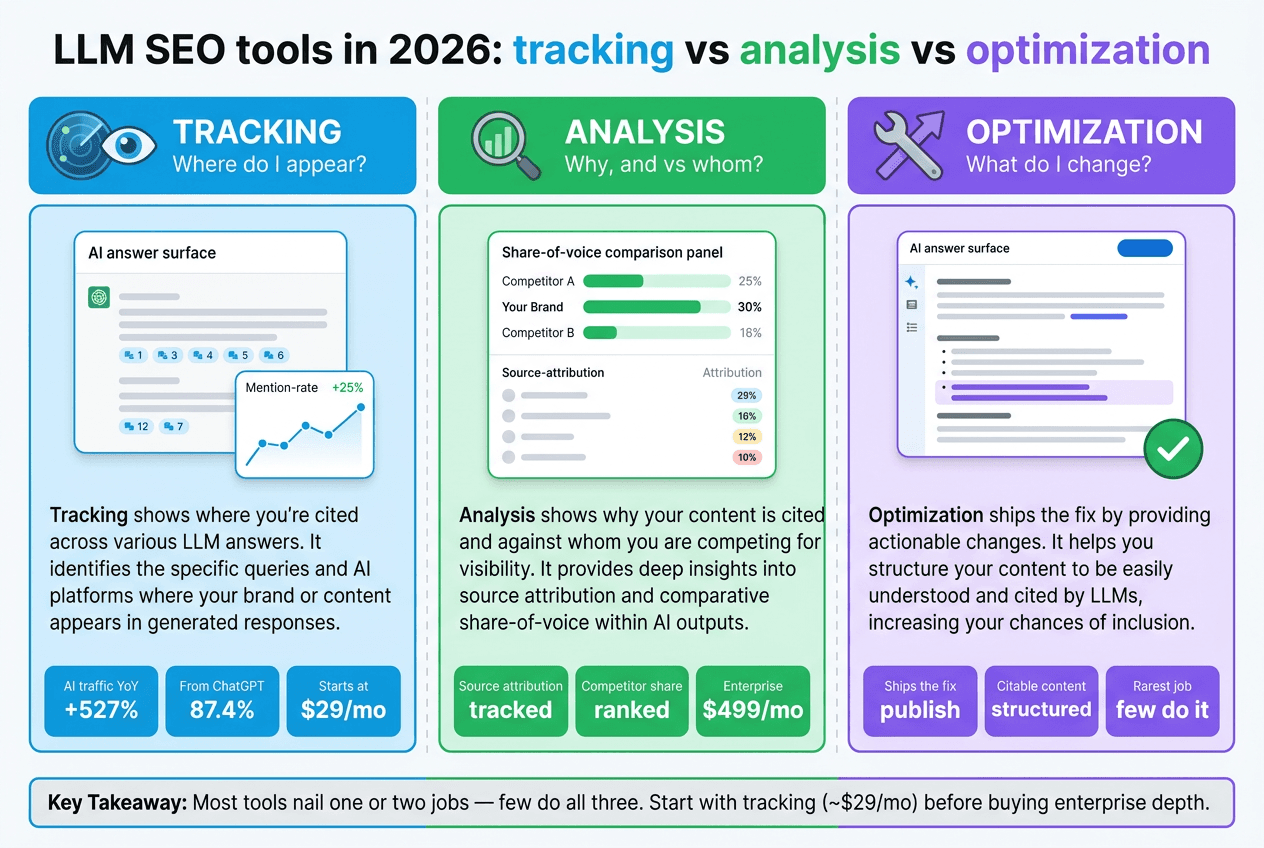
- LLM SEO tools do three different jobs: tracking (where do I appear?), analysis (why, and vs whom?), and optimization (what do I change?). Most nail one or two; few do all three.
- Start cheap. Budget trackers run
$29–59/mo (Otterly, Knowatoa). Don't buy enterprise depth ($499/mo) until you've confirmed a gap worth defending.
What is an LLM SEO tool?
An LLM SEO tool measures whether your brand appears inside AI-generated answers, and how. It runs a defined set of prompts across ChatGPT, Perplexity, Gemini, and Google's AI Overviews, then reports your mention rate, citation share, answer position, and sentiment. Think of it as rank tracking for a world where the rank is a sentence in a chatbot reply — and the data never shows up in your Search Console.
Why is this its own product category and not just another analytics tab? Because the moment of influence happens upstream of any click you can log. When an LLM summarizes your category and names three tools without yours, no referral fires and nothing reaches GA4. The behavior is also concentrating where it hurts most: across 1.96 million LLM-driven sessions, AI traffic landed disproportionately on high-intent pages like pricing and comparison content (Previsible, 2025). That's the bottom of your funnel, decided in a conversation you never saw.

Here's the reframe most listicles skip: an LLM has no #1, so "rank tracking" is the wrong mental model. A generated answer is probabilistic — ask the same question twice and the cited sources can shift. A tool that hands you a single, stable "rank" for ChatGPT is selling a comforting fiction. What you actually want is share of voice across repeated runs: how often you're mentioned, how often you're cited as the source, and whether the framing helps or hurts. If you want the conceptual grounding first, our guide to generative engine optimization explains the levers these tools measure, and the breakdown of llms.txt covers the on-page plumbing they check.
LLM SEO vs traditional SEO: what's different?
The core difference is one word: position becomes probability. Traditional SEO tracks a fixed rank on a static page; LLM SEO tracks how likely you are to be named in an answer that's regenerated every time. The click economics flip too — 93% of Google AI Mode answers end without a click (Semrush, 2025), so being cited in the answer is the impression. There's no blue link below to optimize toward.
The second change is fragmentation. It's not one engine anymore — it's five, and they're growing at wildly different rates. Tracking only ChatGPT leaves the rest of the surface dark. Across that 1.96-million-session dataset, Copilot grew 25.2x year over year, Claude 12.8x, and ChatGPT 3.26x (Previsible, 2025). The laggard today can be the channel that matters in two quarters, which is the whole argument for a tool that watches all of them at once.
So your old rank tracker isn't wrong — it's just blind to half the map now. The full field of AI visibility tools, including the enterprise monitors beyond this rank-tracker lane, is mapped in our category guide. The tools below are the ones you point at the surface once you've done the on-page work.
What are the three jobs of an LLM SEO tool?
Most buyers treat "LLM SEO tool" as one thing. It's three. The category splits cleanly into tracking (where do I appear?), analysis (why, and against whom?), and optimization (what do I change?) — and almost no tool does all three well. Knowing which job you're buying for is the difference between a useful subscription and a dashboard you stop opening in week three.
Tracking is the floor. A tracking tool (the llm seo tracking tool category) answers presence and trend: are we cited, on which engines, how often, and is the line going up or down? This is where the volatility bites.
Our read: when we ran Sivon's own AI Visibility audit repeatedly against a sample brand, the surprise wasn't the citation rate — it was how unstable it was. A brand named by ChatGPT on Monday could be gone by Thursday with no site change at all. That week-to-week drift is the real case for tracking over a one-time check: a single snapshot tells you almost nothing about a moving target.
Analysis goes a level deeper. An analysis tool (the llm seo analysis tool category) answers why — which sources the model pulled from, which competitors it favored, and what sentiment surrounds your mentions. Optimization is the rarest job. An optimization tool (the llm seo optimization tool category) tells you what to change and, ideally, helps you ship it — the citable, structured content the model can actually quote. The chart below maps how far each tool in this guide carries you across those three stages.
What are the best LLM SEO tools in 2026?
The best LLM SEO tools in 2026 sort by job, not by price — and the right one depends on whether you need to watch your AI visibility, understand it, or fix it. Below is the comparison, then a short read on each. Investors are betting the category is permanent: Profound raised $96M at a $1B valuation in February 2026 and counts 700+ enterprises including Target, Figma, and Walmart (SiliconANGLE, 2026). Any of these beats flying blind; the question is fit.

| Tool | Best for | Primary job | Platforms tracked | Entry price (2026)* |
|---|---|---|---|---|
| Profound | Enterprise depth | Analysis | ChatGPT, Perplexity, Gemini, AIO + more | ~$499/mo |
| SE Ranking | Teams already on a rank tracker | Tracking | AI Overview, AI Mode, ChatGPT, Gemini, Perplexity | Add-on |
| LLMrefs | Rank-tracker natives | Tracking | ChatGPT, Perplexity + others | Low-cost |
| Otterly.ai | Budget-conscious starters | Tracking | 6 platforms incl. AI Mode, Copilot | ~$29/mo |
| Peec AI | Mid-market marketing teams | Analysis | ChatGPT, Perplexity, Gemini, AIO | ~€89/mo |
| Frase | Content teams chasing citations | Optimization | Major LLMs | Mid-tier |
| Knowatoa | SMB first look | Tracking | Major LLMs | ~$59/mo |
| Sivon | Small teams that want to act | Optimization | Audit + Pulse monitoring | In-platform |
*Entry pricing per vendor sites and 2026 roundups; verify current rates before buying.
Tracking-led: SE Ranking, LLMrefs, Otterly, Knowatoa
This is where most teams should start, and it's the cheapest tier to be wrong in. SE Ranking folds LLM tracking into a full traditional SEO stack: AI Overview, AI Mode, ChatGPT, Gemini, and Perplexity, all in the dashboard you already use for keywords. That makes it the pragmatic pick if you own the rank tracker already. LLMrefs takes a purely SEO-led angle, offering keyword-style AI rank tracking that feels instantly familiar to anyone who's lived in a rank tool. Otterly.ai punches above its ~$29/mo price with six-platform coverage (including Google's AI Mode and Copilot) and a built-in GEO audit. Knowatoa rounds it out with a free initial audit and daily refresh near $59/mo. For a small team's first 90 days, any one answers the only question that matters early: are we cited at all?
Analysis-led: Profound and Peec AI
When tracking isn't enough and you need to know why, this tier earns its premium. Profound is the reference point for depth. It breaks down how AI engines construct answers and which sources they draw from, and increasingly reports on how AI agents, not just humans, encounter your brand. At ~$499/mo it's built for teams with an analyst to act on the output. Peec AI hits the mid-market sweet spot near €89/mo: it tracks visibility share, position, and sentiment, then goes past raw numbers to recommend specific content changes that could lift your citation rate. If you have a content team and want direction rather than a data lake, Peec is the lighter lift. For the tactics behind what both measure, the Perplexity SEO guide covers the citation factors these tools only report on.
Optimization-led: Frase and Sivon
Here's the tier almost nobody reaches — and the one that actually moves the number. Frase built a "content-to-citation" workflow: it detects where AI isn't citing you, diagnoses why, and generates a brief to fix it. That's a real step past analysis, and for a team with writers ready to execute, it's a strong bridge. Sivon goes one stage further — it doesn't stop at the brief, it ships the page. That distinction is the whole argument of the next section, so let's name it plainly. If you're weighing trackers against the broader market, our best AI visibility tools guide ranks the full category, monitors included — and our AI search visibility tools breakdown splits that field into tracking versus management.
Where does Sivon fit in the LLM SEO stack?
Most LLM SEO tools stop at analysis. They hand you a number that says you're under-cited and, at best, a brief — then the dashboard's job is done and yours begins. Sivon sits deliberately in the optimization lane. Its AI Visibility audit (geo_audit_agent) scores how citable your brand is across AI surfaces. Pulse tracks how that score moves over time. Then comes the part pure trackers skip: the content engines draft the structured, quotable pages that earn the citation, written against your Brand Blueprint so the fix sounds like you.
The split worth naming before you buy is detection versus correction. A tracker tells you where you stand; correction happens elsewhere, usually in a separate content workflow you have to wire up yourself. Frase narrows that gap by generating the brief. Sivon closes it by publishing the page. It won't out-track Profound on raw prompt-set depth — it's built to turn the finding into shipped content in one system, not to win a monitoring arms race.
Sivon's AI Visibility audit and engines close the loop: the audit scores your citability, Pulse watches it change, and the engines publish the fix against your Brand Blueprint. To make a page quotable in the first place, our guides on llms.txt and generative engine optimization cover the on-page work these trackers only measure.
Whichever tier you land in, pair the tracker with a publishing motion. A monitoring subscription with nothing behind it to act on is a very precise way to watch yourself lose. If you'd rather see your standing and act on it in one place, start with Sivon's AI Visibility audit — then layer a dedicated tracker on top only if the depth earns it.
Frequently asked questions
What is an LLM SEO tool?
An LLM SEO tool tracks whether and how your brand appears inside AI-generated answers — ChatGPT, Perplexity, Gemini, and Google AI Overviews. Instead of a numbered Google rank, it measures mention rate, citation share, answer position, and sentiment. With 87.4% of AI referral traffic coming from ChatGPT alone (Similarweb, 2025), strong ChatGPT coverage matters most.
What's the difference between LLM SEO and traditional SEO?
Traditional SEO tracks a fixed position on a results page; LLM SEO tracks probability and share of voice inside a generated answer that changes every run. There's no page two and no stable #1 — you're named in the response or invisible. With 93% of AI Mode answers ending click-free (Semrush, 2025), the citation itself is the win.
How do LLM SEO trackers measure rankings with no #1 position?
They send a fixed set of prompts to each engine on a schedule and record how often your brand is mentioned, cited as a source, and how it's framed. The output is a share-of-voice percentage across repeated runs, not one position. Because answers are non-deterministic, a tool reporting a single fixed "rank" is oversimplifying — repeated sampling is the honest method.
Are LLM SEO tools worth it for a small team?
Yes, but start with a free or one-time audit before a subscription. AI referral traffic grew 527% year over year across 19 GA4 properties (Previsible, 2025), so the channel is real. A small team usually needs to confirm a gap exists once before paying for daily monitoring — audit first, subscribe only if the gap justifies it.
What's the cheapest LLM SEO tool to start with?
Budget trackers start around $29–59/mo — Otterly near $29/mo and Knowatoa around $59/mo with a free initial audit (vendor sites, 2026). That tier answers the early question — are we cited at all? — without an enterprise commitment. Save platforms like Profound (~$499/mo) for when you have a category to defend.
The bottom line
LLM SEO tools turn an invisible, shifting channel into a number you can manage — and in 2026 that channel is no longer optional to watch. The demand is real (527% year-over-year growth, a fresh $1B valuation in the category), but the mistake teams make is treating "LLM SEO tool" as one purchase when it's three. Tracking, analysis, and optimization are different jobs, and very few tools carry you across all of them.
Start with an audit to confirm there's a gap. Choose your tracker by job-fit, not by feature count — and most importantly, wire it to a publishing motion so detection becomes correction. The brands that win the AI answer aren't the ones watching the dashboard hardest; they're the ones shipping the citable content the model wants to quote. Run Sivon's AI Visibility audit and get the finding and the fix in one place.