The best AI visibility tools in 2026: what they track and how to choose
AI platforms send 1.13B referral visits a month and 93% of AI Mode answers end click-free. The best AI visibility tools in 2026 — what they track and how to pick.

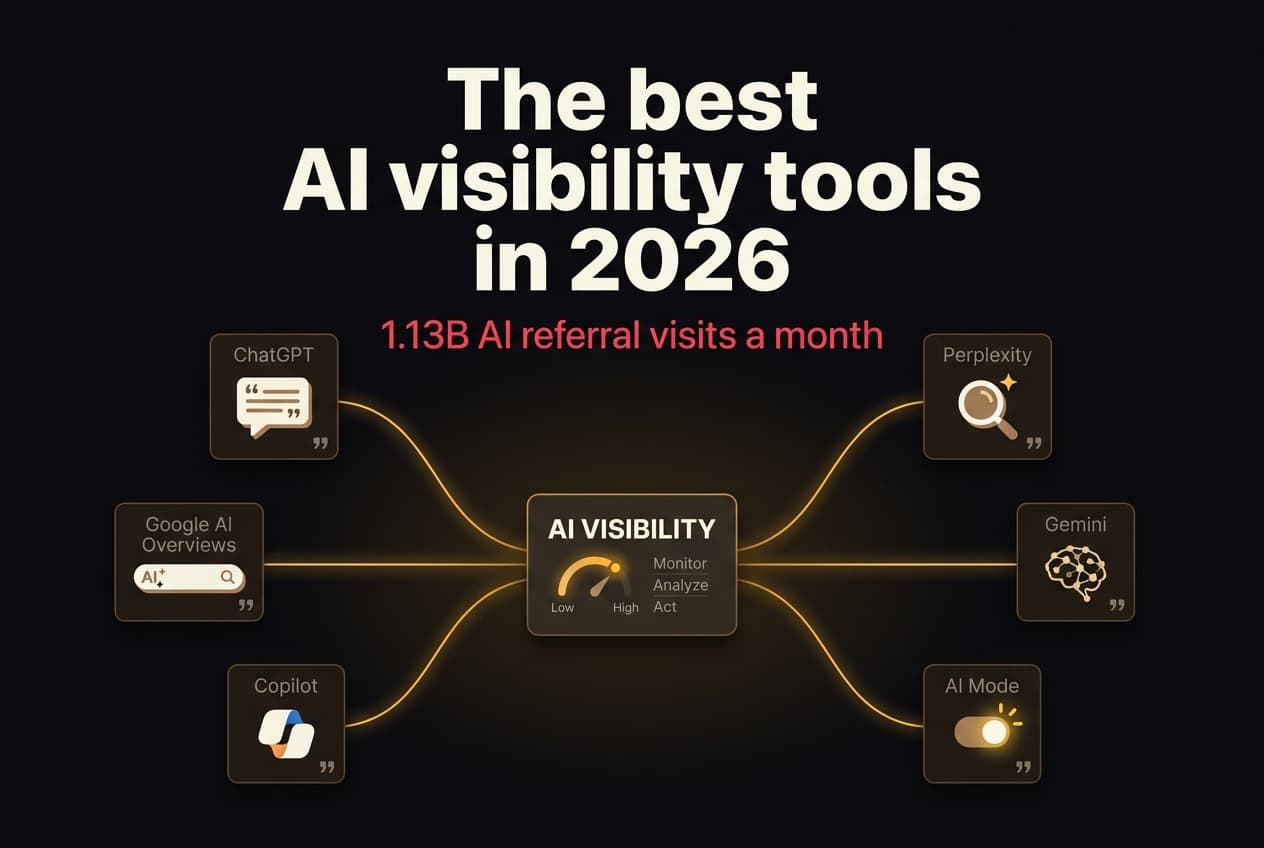
Search your own brand inside ChatGPT and one of two things happens. Either you show up — named, cited, recommended — or you don't, and a competitor does. There's no page two to fall back to, no "almost ranked." In an AI answer you're either in the response or invisible, and most brands have no idea which.
That blind spot is the entire reason AI visibility tools exist. Traditional analytics show you clicks; they can't show you a conversation that ended without one. And those conversations are scaling fast — AI platforms generated over 1.13 billion referral visits in June 2025 (Similarweb, 2025). This guide maps the category, ranks the tools that matter, and gives you a decision tree for picking one without overspending.
Key takeaways
- AI visibility tools track your brand inside AI answers — mention share, citation rate, position, and sentiment across ChatGPT, Perplexity, Gemini, and Google AI Overviews.
- 93% of AI Mode answers end without a click (Semrush, 2025), so being cited in the answer is the impression — there's no link to optimize for.
- Entry pricing spans ~17x, from about $29/mo (Otterly) to ~$499/mo (Profound). Most small teams should start with an audit, not a subscription.
- The category's blind spot: nearly every tool monitors visibility; very few help you act on it. Detection without a fix is a more expensive way to feel behind.
What are AI visibility tools?
AI visibility tools measure whether your brand appears in AI-generated answers, and how. They run a defined set of prompts across ChatGPT, Perplexity, Gemini, and Google's AI Overviews, then report your mention frequency, citation share, answer position, sentiment, and how you stack up against competitors. Think of it as rank tracking for a world where the "rank" is a sentence in a chatbot's reply.
The reason this is a new product category — and not just a Search Console tab — is that the data is invisible to standard analytics. When ChatGPT recommends three tools and skips yours, no referral fires, no impression logs, nothing shows up in GA4. Across ten major industries, 87.4% of AI referral traffic comes from ChatGPT alone (Similarweb, 2025), yet the moment of influence happens upstream of any click you can track.

So what do these tools actually fall into? Four overlapping jobs, and most platforms emphasize one or two:
| Category | What it answers | Example terms it owns |
|---|---|---|
| AI search / GEO monitoring | Are we cited in AI answers, and where? | ai visibility tools, ai search visibility tools |
| LLM SEO trackers | How do we rank across LLMs, keyword by keyword? | llm seo tool, chatgpt seo tracking tools |
| AEO (answer engine optimization) | Are we the source the answer engine quotes? | answer engine optimization tools |
| AI brand monitoring | Where, and how favourably, is our brand mentioned? | ai brand monitoring tools, brand visibility in ChatGPT |
If you want the conceptual grounding before the tooling, our guide to generative engine optimization explains the levers these tools measure, and the AI search optimization guide covers the surfaces they track.
Why do AI visibility tools matter in 2026?
They matter because the answer is replacing the link, and the answer is where buying decisions now start. Google AI Overviews peaked at just under 25% of queries in 2025 before settling lower (Semrush, 2025), and on the queries where AI answers appear, the click is increasingly optional. When the model summarizes your category and names a winner, that recommendation is the funnel's top.
The traffic that does come through converts. ChatGPT ecommerce traffic converted at 1.81% versus 1.39% for non-branded organic search — 31% higher — across 94 sites over 2025 (Visibility Labs via Search Engine Land, 2025). In the same study, ChatGPT visits to those brands grew 1,079% in a single year. People who arrive from an AI recommendation arrive pre-qualified — the model already vouched for you.
Here's the catch that makes monitoring non-optional: you can't manage what you can't see, and the click economics have flipped. Only 1% of users click a link inside an AI Overview (Pew Research, 2025). If the answer doesn't name you, you got nothing — not a click, not an impression, not a data point. The tools below exist to turn that silence into a measurable number.
The best AI visibility tools in 2026
The best AI visibility tools fall into four tiers — enterprise depth, mid-market usability, budget trackers, and audit-and-act systems — and the right one depends less on features than on your team size and what you'll do with the data. Below is the comparison, then a short profile of each. ChatGPT referrals grew 52% year over year in late 2025 (Adobe via Digiday, 2025), so any of these beats flying blind — the question is fit, not whether to track at all.
| Tool | Best for | Platforms tracked | Entry price (2026)* | Standout |
|---|---|---|---|---|
| Profound | Enterprise / deep analysis | ChatGPT, Perplexity, Gemini, AIO + more | ~$499/mo | Behavioral depth, agent analytics |
| Scrunch AI | Enterprise / agencies | ChatGPT, Perplexity, Google AIO, Copilot | ~$250/mo | Monitor → Analyze → Optimize, persona modeling |
| Peec AI | Mid-market marketing teams | ChatGPT, Perplexity, Gemini, AIO | ~€89/mo | Fast, usable; visibility share + sentiment |
| Otterly.ai | Budget-conscious teams | 6 platforms incl. AI Mode, Copilot | ~$29/mo | 40+ countries, built-in GEO audit |
| Semrush AI Toolkit | Existing Semrush users | ChatGPT, Perplexity, Gemini | Add-on | Folds AI visibility into a stack you own |
| Knowatoa | SMB starters | Major LLMs | ~$59/mo | Free audit, daily refresh, BISCUIT framework |
| LLMrefs | SEO-led B2B teams | ChatGPT, Perplexity + others | Low-cost | Keyword-style AI rank tracking |
| Sivon | Small teams that want to act | Audit + Pulse monitoring | In-platform | Pairs the audit with engines that fix it |
*Pricing per vendor sites and 2026 roundups; verify current rates before buying.
Enterprise tier — Profound and Scrunch
If you have a category to defend and a budget to match, this tier goes deepest. Profound is the reference point for behavioral depth — it tracks mention frequency, recommendation context, and answer position across a wide prompt set, and increasingly reports on how AI agents, not just humans, encounter your brand. Scrunch AI organizes around three pillars — Monitor, Analyze, Optimize — and adds persona and language modeling plus funnel analysis, which is why agencies running multiple clients gravitate to it. Both reward teams with an analyst to act on the output.
Mid-market tier — Peec AI, Otterly, and Semrush
This is the sweet spot for most in-house marketing teams. Peec AI monitors visibility share, position, and sentiment across ChatGPT, Perplexity, Gemini, and AI Overviews, and surfaces recommended actions — fast to set up, easy to read. For the dedicated brand-mention monitors in this lane, our AI brand monitoring tools guide compares them head to head. Otterly.ai punches above its price: six-platform tracking (including Google's AI Mode and Copilot), 40+ country coverage, and a built-in GEO audit that checks 25+ on-page factors, used by 20,000+ marketers. And if you already pay for Semrush, its AI Toolkit folds brand-mention tracking into a stack you own — often the pragmatic first step. For the tactics behind what these tools measure, the Perplexity SEO guide and how to rank in ChatGPT cover the citation factors directly. For trackers scoped to one engine, our ChatGPT SEO tracking tools guide covers the ChatGPT-specific lane.
Budget and starter tier — Knowatoa and LLMrefs
You don't need enterprise pricing to answer "are we visible at all?" Knowatoa gives daily data refreshes, a free initial audit, and its BISCUIT framework that reverse-engineers how AI systems make recommendations — around $59/mo. LLMrefs takes an SEO-led angle, offering keyword-style AI rank tracking that feels familiar to anyone who's lived in a rank tracker. Both are strong for a small team's first 90 days. The low-difficulty LLM SEO tools segment lives here, and it's where most teams should start — the cost of a wrong call is $59, not a year's contract.
Audit-and-act tier — Sivon
Most tools in this guide are dashboards: they tell you you're invisible and leave the fixing to you. Sivon sits deliberately in a different lane. Its AI Visibility audit scores how citable your brand is across AI surfaces, Pulse tracks mentions and citations over time, and — the part the pure monitors skip — the same system carries the content and distribution engines to publish the fix. For a two-to-ten person team that wants detection and action in one place, not a monitoring bill plus a separate content workflow, that's the trade. It won't out-monitor Profound on raw depth; it's built to close the loop instead.
How do you choose the right AI visibility tool?
Choose by answering three questions in order: how big is your team, what's your budget, and — the one most buyers skip — what will you do the day after the dashboard says you're invisible? AI-driven traffic to retail sites jumped 12x between July 2024 and February 2025 (Adobe, 2025), so the urgency is real, but urgency is exactly what leads teams to overbuy.
A rough decision tree:
- Solo or under 5 people, first look: start with a free or one-time audit (Knowatoa, Otterly, or Sivon's AI Visibility audit). Don't pay for daily monitoring until you've confirmed there's a gap worth watching.
- In-house team of 5–20: a mid-market tracker — Peec or Otterly — or your existing Semrush stack. You want a weekly read and clear actions, not an analyst's playground.
- Agency or enterprise: Profound or Scrunch, for prompt-set depth, multi-client workspaces, and persona modeling.
- Want the fix, not just the finding: an audit-and-act system so detection feeds straight into publishing.
And if your need is narrower — pure rank tracking rather than full monitoring — weight the trackers (LLMrefs, Otterly) over the analysis-heavy platforms. You can always add depth later; you can't easily get a year's budget back.
The gap most AI visibility tools share
Here's the pattern almost no roundup admits: the category is excellent at detection and thin on correction. Run any of these tools and you'll get a number that says you're under-cited. Then what? The dashboard's job is done; yours is just beginning. Across 973 ecommerce sites, AI referral traffic still trailed Google on revenue per session (Search Engine Land, 2025) — proof that visibility alone isn't the finish line. Acting on it is.
Our read: when we built Sivon's AI Visibility audit, the recurring failure we saw wasn't crawlability — it was the absence of citable, structured content for the model to quote. Brands weren't invisible because AI couldn't reach them; they were invisible because there was nothing clean to lift. Fixing that is a content problem, not a monitoring one.
That's the strategic split worth naming before you buy. Monitoring tools answer "where do we stand?" Optimization happens elsewhere — usually in a separate content workflow you have to wire up yourself. The chart below is our categorization of how far the typical tool carries you, not a vendor stat, but the shape matches what the market ships.
Sivon's AI Visibility audit and engines close that loop: the audit scores your citability across AI answers, Pulse tracks how it changes, and the content engines draft the structured, quotable pages that earn the citation — against your Brand Blueprint, so the fix sounds like you. To make your pages quotable in the first place, our guides on llms.txt and ranking in ChatGPT cover the on-page work these tools only measure.
Whichever tier you land in, pair the tracker with a publishing motion. A monitoring subscription with no content engine behind it is a very precise way to watch yourself lose. If you'd rather see your standing and act on it in one place, start with Sivon's AI Visibility audit — then layer a dedicated monitor on top only if the depth earns it.
Frequently asked questions
What are AI visibility tools?
AI visibility tools track whether and how your brand appears inside AI-generated answers — ChatGPT, Perplexity, Gemini, and Google AI Overviews. They measure mention frequency, citation share, answer position, and sentiment. With AI platforms generating over 1.13 billion referral visits in June 2025 (Similarweb, 2025), they cover a surface standard analytics can't see.
What are the best AI visibility tools in 2026?
Profound and Scrunch lead on enterprise depth; Peec AI, Otterly, and Semrush's AI Toolkit serve the mid-market; Knowatoa and LLMrefs cover budget tracking. Sivon sits in a separate audit-and-act tier. Since 87.4% of AI referral traffic comes from ChatGPT (Similarweb, 2025), prioritize strong ChatGPT coverage.
How much do AI visibility tools cost?
Entry pricing spans roughly 17x — from about $29/mo (Otterly) to ~$499/mo (Profound), with mid-tier platforms like Scrunch near $250/mo (vendor sites, 2026). Most small teams don't need enterprise depth; a one-time audit or sub-$60 tracker answers the first question — are we visible at all?
Do AI visibility tools actually improve rankings in ChatGPT?
No — monitoring measures visibility; it doesn't change it. Only 1% of users click links inside an AI Overview (Pew Research, 2025), so the citation itself is the win. Improving it takes citable, structured content — which is why audit-and-act tools move faster than dashboards alone.
Are AI visibility tools worth it for a small team?
Yes, but start with an audit, not a subscription. ChatGPT referrals grew 52% year over year in late 2025 (Adobe via Digiday, 2025), so the channel is real. But a small team usually needs to know where it stands once before paying for daily monitoring — run a free or one-time audit first.
The bottom line
AI visibility tools turn an invisible channel into a number you can manage — and in 2026, that channel is no longer optional to watch. The category is real, the demand is climbing, and the pricing spans 17x, so the mistake isn't picking the wrong tool; it's overbuying a dashboard before you've confirmed a gap, or buying monitoring with nothing behind it to act on.
Start with an audit. Confirm where you stand inside ChatGPT, Perplexity, and AI Overviews. Then choose your tier by team size, and — most importantly — wire the tracker to a publishing motion so detection becomes correction. The brands that win the AI answer aren't the ones watching the dashboard hardest; they're the ones shipping the citable content the model wants to quote.
Ready to see where you stand? Run Sivon's AI Visibility audit and get the finding and the fix in one system.