What is a fractional CMO? A plain-English guide for small teams
A fractional CMO is a part-time marketing executive — strategy without the $290K hire. What they do, what they cost, and when to hire one.

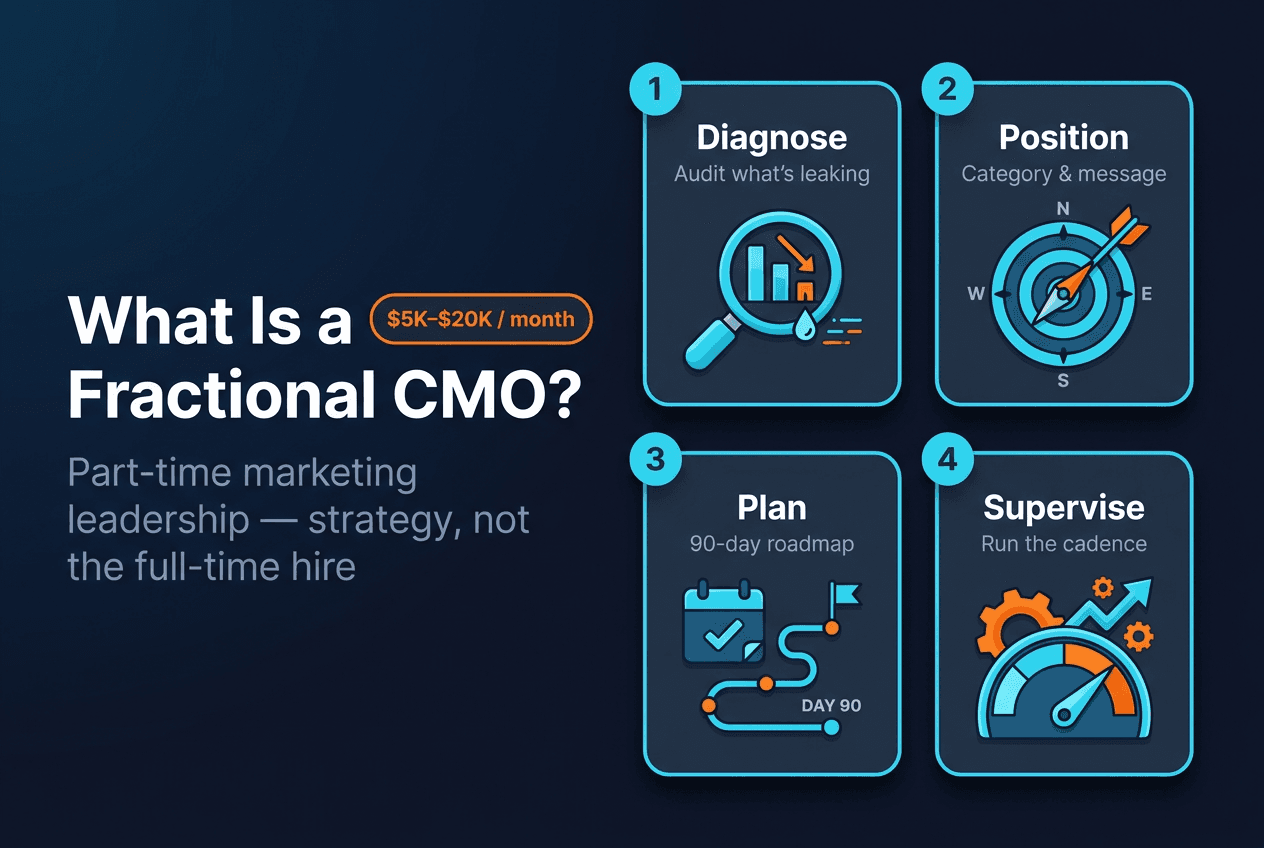
A fractional CMO is a senior marketing executive who runs your marketing strategy part-time — a fraction of a full-time chief marketing officer's hours, for a fraction of the cost. Instead of a single ~$290,000-a-year hire, you get executive-level marketing leadership on a monthly retainer, usually one to two days a week.
The model exists because most small companies share one problem: marketing is happening, but no one senior owns the direction. A founder writes the landing page, an engineer runs the ads, a contractor ships blog posts — and none of it ladders up to a strategy. A fractional CMO is the person who decides what the marketing is actually for. This guide defines the role plainly, then covers what they do, how engagements are structured, what they cost, and when a small team genuinely needs one — or whether an AI CMO now does the job instead.
Key Takeaways
- A fractional CMO is a part-time marketing executive who sets strategy and supervises execution — typically $5K–$20K/month, most engagements landing near $10K–$12K (Growtal, 2026).
- That's a fraction of a full-time CMO's ~$293,575 average total compensation (Built In, 2026).
- Their job is four things — diagnose, position, plan, and supervise. It's judgment, not production. They don't write your blog posts.
- Hire one when your direction is unclear, not when you simply need more output. If positioning is already sharp, you're buying expensive oversight.
- The modern alternative is an AI CMO — software that holds your strategy and runs execution for $30–$500/month. Different trade-offs; see the fork below.
What is a fractional CMO, exactly?
A fractional CMO is a marketing leader you hire on a part-time, ongoing basis to own strategy — the same role a full-time chief marketing officer plays, scaled to the hours a smaller company actually needs. "Fractional" just means you're buying a fraction of an executive's week, not their whole calendar. 9% of SMBs are now working with or planning to hire one, up from 5% the year before (Rick Ramos, 2024).
The label gets blurry, so it helps to say what a fractional CMO is not. A consultant audits and advises, then leaves you to execute. An agency runs campaigns against a brief someone else writes. A freelancer fills a single skill gap — copy, design, paid media. A fractional CMO sits above all of them: they set the direction, write the brief, and hold the agencies and freelancers accountable to it. They're a member of your leadership team who happens to work two days a week.
That distinction matters more than it sounds. The newest version of this role isn't human at all, which is why it's worth comparing carefully — see our guide to a fractional CMO versus an AI CMO for the full picture.
What does a fractional CMO actually do?
A fractional CMO does four things, in order: diagnose, position, plan, and supervise. Notice what's missing — production. They're paid for judgment, not output, which is the single most common thing small teams misread when they hire one. 75% of SMBs are already experimenting with AI (Salesforce, 2025) to handle the production half; the fractional CMO owns the strategy half.
Put plainly, diagnose finds what's leaking before anything ships. Position decides what category you compete in and the one or two messages that win — the work nothing downstream can fix if it's wrong. Plan turns that into a 90-day roadmap with channels, budget, and a definition of success. Supervise is the weekly hand on the wheel: brief the freelancers, review the work, read the numbers, adjust.
Here's why so many fractional CMO engagements disappoint, and it's rarely competence — it's a mismatch. Teams hire one expecting a senior pair of hands to do the marketing, then feel shortchanged when deliverables come slowly. A fractional CMO who's personally writing your emails is a $250-an-hour copywriter. The value is in the four jobs above, and especially the first two.
How are fractional CMO engagements structured?
Most fractional CMO engagements take one of four shapes, and the right one depends on how settled your strategy already is. The common thread is part-time and ongoing — usually 5 to 20 hours a week — but how those hours are bought varies. Retainers dominate, because marketing strategy is a cadence, not a one-off project you finish and walk away from.
| Model | Typical commitment | Best when | Rough monthly |
|---|---|---|---|
| Monthly retainer | 1–2 days/week, ongoing | You need continuous strategic ownership | $5K–$20K |
| Project / sprint | Fixed scope, 4–12 weeks | A launch, rebrand, or repositioning | $8K–$25K total |
| Advisory | A few hours/month | Strategy is set; you want a sounding board | $2K–$5K |
| Fractional-to-hire | Part-time, converting to full-time | Testing the role before a full commit | $5K–$15K |
The retainer is the default for a reason: positioning and planning aren't things you buy once. Markets move, campaigns underperform, and the plan needs a hand on it every week. Advisory is the lightest touch — useful once your direction is clear and you mostly need someone senior to pressure-test decisions. The fractional-to-hire path has grown as a low-risk way to audition the role before committing to a full-time salary, which, as the next section shows, is a very different number.
How much does a fractional CMO cost?
A fractional CMO costs $5,000 to $20,000 per month, with most engagements averaging $10,000–$12,000 (Growtal, 2026). Entry-level engagements for very small companies start around $2,000–$5,000 a month, which typically buys 5–10 hours a week — about a day of senior thinking. The number that makes the whole model make sense is the comparison: a full-time CMO's average total compensation runs about $293,575 a year (Built In, 2026), or roughly $24,000 a month before benefits and equity.
So the pitch is straightforward: executive marketing judgment at a third to a tenth of the full-time price, with no equity and no severance. For a small company that can't justify — or attract — a $290K marketing hire, that's the entire appeal. The catch is that you're buying hours, and hours cap out; a fractional CMO at two days a week can direct your marketing, but they can't also execute all of it. For what pushes the number up or down and how to budget for it, see our breakdown of fractional CMO costs.
When should a small team hire a fractional CMO?
Hire a fractional CMO when your marketing direction is unclear — not when you simply need more content. The clearest signal is the two-sentence test: if you can't state your positioning and ideal customer in two sentences without reaching for a deck, that's a strategy gap a fractional CMO is built to close. An output gap is a different problem with a different fix.
A few concrete triggers that mean it's time:
- You're about to launch or raise, and the story still isn't sharp.
- Marketing is busy but flat — lots of activity, no compounding results.
- A founder has run marketing on instinct and hit the ceiling of that instinct.
- You're spending real money on channels with no one senior reading the numbers.
And the cases where you don't need one? If positioning is already clear and the bottleneck is purely execution speed, a fractional CMO is expensive oversight. 60% of companies generate no material value from their AI and marketing investments (BCG, 2025) — usually because they bought capacity when the missing piece was direction, or direction when the missing piece was capacity. Diagnose which half is actually broken before you spend. For the wider operating model of a lean marketing function, our marketing team of one guide is a useful companion read.
A fractional CMO — or an AI CMO?
There's a newer answer to the same problem, and it's worth naming honestly. An AI CMO is software that holds your business context — positioning, ideal customer, voice, competitors — and applies it across every channel automatically: diagnosing gaps, recommending the next move, and producing the work. It targets the same job a fractional CMO does, at $30–$500 a month instead of $5K–$20K.
The two aren't clean substitutes. A fractional CMO brings executive judgment, accountability, and the unwritten context a human absorbs in your standups — and they can be fired if it isn't working. An AI CMO brings speed, scale, and a strategy that never starts from zero, but it won't sit in your leadership meeting or own a number with its name on it. The honest version of that trade-off — six dimensions, with a verdict — lives in our fractional CMO vs AI comparison, and the full decision framework is in the AI CMO vs fractional CMO pillar.
This is the lane Sivon works in: an AI marketing team that learns your business once through a Brand Blueprint, then diagnoses, plans, and produces against it — so the output sounds like you, not like a generic prompt. It isn't a replacement for executive judgment on the hardest strategic calls. It's the option for teams whose direction is reasonably clear and whose real bottleneck is shipping good marketing, consistently, without a $10K retainer. If that's the half that's broken for you, you can see how Sivon's plans compare.
Frequently asked questions
What is a fractional CMO?
A fractional CMO is a senior marketing executive who runs your marketing strategy part-time — the same role as a full-time chief marketing officer, scaled to the hours a smaller company needs. Most engagements run $5K–$20K/month (Growtal, 2026), versus a full-time CMO's ~$293,575 average total compensation.
What does a fractional CMO do?
A fractional CMO does four things: diagnose (audit where marketing stands), position (decide the category, ICP, and message), plan (build the 90-day roadmap), and supervise (brief the team and read the numbers). They're paid for judgment, not production — 75% of SMBs already use AI for the output half (Salesforce, 2025).
How much does a fractional CMO cost?
A fractional CMO costs $5,000–$20,000 per month, with most engagements averaging $10,000–$12,000 (Growtal, 2026). Entry-level engagements for very small companies start around $2,000–$5,000/month, buying roughly 5–10 hours a week — about a day of senior thinking.
When should you hire a fractional CMO?
Hire a fractional CMO when your marketing direction is unclear — not when you only need more output. The clearest signal is the two-sentence test: if you can't state your positioning and ideal customer without reaching for a deck, that's a strategy gap. 9% of SMBs now use or plan to hire one, up from 5% (Rick Ramos, 2024).
Fractional CMO vs full-time CMO — what's the difference?
A full-time CMO is a salaried executive owning marketing five days a week; a fractional CMO does the same strategic job part-time, usually one to two days. The gap is cost: a full-time CMO averages ~$293,575 in total compensation (Built In, 2026), while a fractional CMO runs $5K–$20K/month with no equity or severance.
The bottom line
A fractional CMO is the part-time marketing executive a small company hires when it needs direction more than hands — someone to diagnose, position, plan, and supervise for a fraction of a full-time hire's ~$293K cost. Hire one when your strategy is genuinely unclear; skip it when you only need faster execution.
The new wrinkle is that "a fraction of a CMO" is no longer the only way to get marketing leadership without a full-time salary. An AI CMO does a meaningful slice of the same job for a fraction of even the fractional price — with different trade-offs around judgment and accountability. Which one fits depends entirely on which half of your marketing is broken: the thinking, or the doing. Start with that diagnosis, compare the two models honestly, and buy the fix for the problem you actually have.