Fractional CMO cost in 2026: real rates, pricing models, and the cheaper AI alternative
Fractional CMOs run $5K–$20K/mo (most $10–12K) or $200–$350/hr in 2026. The full rate breakdown by model — and the cheaper AI alternative.

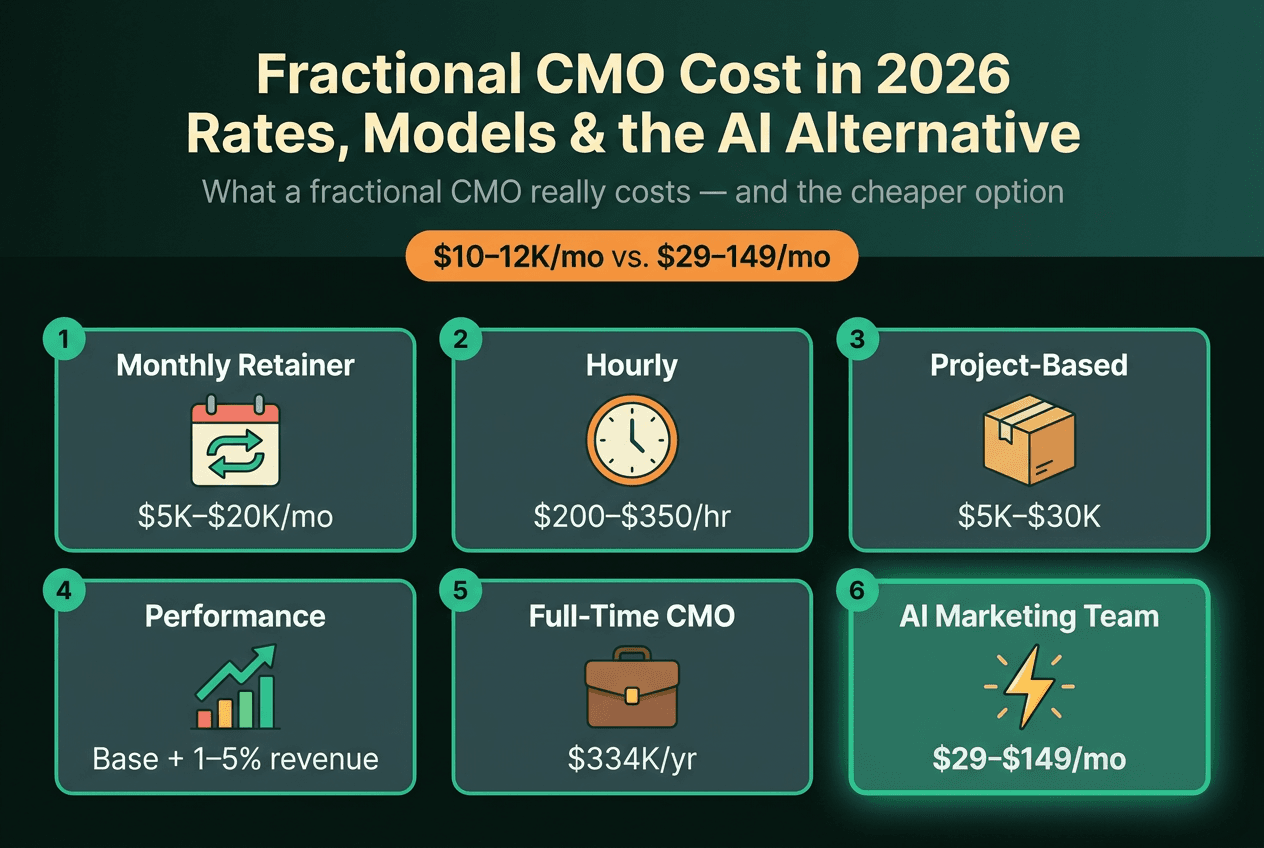
A fractional CMO costs $5,000 to $20,000 a month, with most engagements landing around $10,000–$12,000 (Growtal, 2026). If you'd rather pay by the hour, senior operators charge $200–$350, climbing past $500 at the top of the market (Revenue Nomad, 2026). That's the short answer.
The longer one — which pricing model fits a 2-to-10-person team, what actually moves the number, and whether a $29–$149/month AI alternative covers the same ground — is what the rest of this breakdown is for. If you're still deciding between a human and software in the first place, start with the head-to-head in our AI CMO vs. fractional CMO guide.
Key Takeaways
- Fractional CMO retainers run $5K–$20K/month, most around $10K–$12K (Growtal, 2026); hourly work is $200–$350+ (Revenue Nomad, 2026).
- A fractional CMO costs about 64% less than a full-time hire — roughly $120K/yr versus $334K fully loaded.
- Four pricing models exist: retainer, hourly, project, and performance. The model you pick matters as much as the rate.
- The honest verdict: a fractional CMO buys strategy and accountability; a $29–$149/month AI marketing team buys execution. Most small teams need the second far more than the first.
How much does a fractional CMO cost in 2026?
Plan on $5,000–$20,000 a month, with the typical growth-stage engagement around $10,000–$12,000 (Growtal, 2026). Early-stage companies pay less — roughly $2,000–$5,000/month — but that buys 5–10 hours a week, about a day of senior thinking. The headline number depends almost entirely on how much of someone's week you're renting.
Annually, the contrast with a full-time hire is the real story. A full-time CMO costs around $334,000 a year fully loaded — salary, bonus, benefits, recruitment — while a fractional CMO at $10,000/month runs about $120,000, a 64% saving (Revenue Nomad, 2026). For a small company that can't justify a full-time executive, that's the entire appeal.
But the annual figure flatters the fractional model. You're not buying a year of attention — you're buying a slice of one. A $120K fractional engagement might be 10–15 hours a week. The right comparison isn't full-time versus fractional. It's what does each dollar actually buy? — and that depends on which pricing model you sign.
The four ways a fractional CMO charges
Fractional CMOs bill four ways — retainer, hourly, project, and performance — and the model shapes your cost as much as the rate (Growtal, 2026). A $300 hourly rate and a $12,000 retainer can describe the same operator; what changes is what you're paying for. Here's how the models break down and who each one fits.
| Pricing model | Typical 2026 range | Best for |
|---|---|---|
| Monthly retainer | $5K–$20K/mo (most $10K–$12K) | Ongoing leadership, 6+ month engagements |
| Hourly | $200–$350/hr (up to $500+) | One-time audits, short advisory bursts |
| Project-based | $5K–$30K per project | A defined deliverable — launch, rebrand, GTM plan |
| Performance-based | Reduced retainer + 1–5% of attributable revenue | Aligning cost to growth at later stages |
Most experienced operators prefer the retainer, because hourly billing rewards activity instead of outcomes — and a senior leader's value is in the calls they make, not the hours they log. Performance models are rarer and trickier: a reduced base plus 1–5% of attributable revenue growth (Growtal, 2026) sounds aligned, but attribution at a small company is messy enough to start arguments. For a first engagement, a fixed retainer with written deliverables is the cleanest deal.
What drives a fractional CMO's rate?
The spread from $2,000 to $25,000 a month comes down to five factors: seniority, scope, time commitment, industry, and your company's stage (Revenue Nomad, 2026). A former VP of Marketing at a known brand, building and managing your team three days a week, sits at the top. An advisor reviewing your plan for five hours sits at the bottom.
Two factors get underweighted. The first is engagement length: most fractional CMOs ask for a minimum of six months, because strategy needs time to show results, and a one-month trial usually wastes everyone's money (Growtal, 2026). The second is specialization — a B2B SaaS or regulated-industry operator commands a premium because the playbook transfers. If you're unsure what the role even covers at your stage, our explainer on what a fractional CMO actually does maps the scope before you price it.
Is a fractional CMO worth it for a small team?
For a 2-to-10-person team, a fractional CMO is worth it only when the problem is strategy, not execution. The 64% saving versus a full-time hire is real, but $10K–$12K a month is still a meaningful line item when you're pre-revenue or running lean. The question isn't whether it's cheaper than a CMO. It's whether you need a marketing leader at all yet.
Here's the part the rate guides skip: you don't hire a fractional CMO for output — you hire them for the no. Every bad campaign they talk you out of, every channel they tell you to ignore, every "your positioning is the problem, not your ad spend" — that's the retainer earning its keep. If your positioning is already sharp and your ICP fits in two sentences, you're paying executive rates for execution oversight you don't need.
So the honest test is one question: can you articulate your positioning in two sentences without reaching for the deck? If the answer is no, a fractional CMO for two quarters is money well spent. If the answer is yes, your bottleneck is shipping, not strategy — and that's a far cheaper problem to solve.
The cheaper alternative: an AI marketing team at $29–$149/month
If execution is your bottleneck, an AI marketing team costs $29–$149/month — roughly 1/100th of a fractional CMO retainer — and ships across every channel without capping at hours sold. The catch is what it doesn't do: it won't sit in your leadership meeting, won't diagnose ambiguous positioning, and won't be accountable when a quarter misses. So compare them honestly, line by line.
| Fractional CMO | AI marketing team (Sivon) | |
|---|---|---|
| Monthly cost | $5K–$20K | $0–$149 |
| Sets strategy & positioning | Yes — executive judgment | Partly — needs a sharp brief |
| Executes across channels | Delegates it | Yes — content, social, ads, outreach |
| Persistent business context | In their head | Documented, reusable, applied everywhere |
| Accountable & fireable | Yes | No — the call is always yours |
The line that matters most is persistent context. A fractional CMO carries your business in their head — and walks out with it when the engagement ends. An AI marketing team keeps your positioning, ICP, and voice on file and applies them to every output automatically, so nobody re-explains the business at the start of each task. That's the whole argument for AI over a human at this stage, and it's why the comparison isn't really "cheaper" — it's "different layer."
What we see in conversations with small teams is consistent: the ones happiest with AI marketing are the ones where one person clearly owns marketing and can write a sharp brief. The ones who bounce off it are waiting for the tool to decide strategy for them. AI is a force multiplier on a clear direction — and a confusion multiplier without one. See how the persistent-context system works, or what each plan costs, before you decide which layer you're actually missing.
The bottom line: which line item earns its keep?
If a small team asked us privately, ignoring the pitch decks: hire a fractional CMO when positioning is genuinely unclear — scope it as a finite two-quarter engagement with written deliverables, not an open retainer. The companies that get value treat it as a project, not a subscription.
Run an AI marketing team when positioning is sharp and you're shipping one piece of content a week instead of ten. At $29–$149/month against a $10K–$12K retainer, the math only goes one way once strategy is settled. And if you genuinely can't tell which problem you have, that ambiguity is itself the signal — read the full AI CMO vs. fractional CMO breakdown, then price the layer you're actually missing. The thing worth budgeting for at this size isn't a person or a tool. It's the documented context any human or AI can pick up and run with.