AI CMO vs fractional CMO: what an 'AI CMO' actually is — and when each is the right call
Fractional CMOs run $5K–$20K/mo. An 'AI CMO' is a new category: what it is, how it differs from a human and a generic AI tool, and when each wins.

Search "what is an AI CMO" and you'll get two kinds of answers: breathless launch posts, and people insisting it's a marketing gimmick. Both miss it.
An AI CMO is a marketing system that owns the job a chief marketing officer does — diagnose what's broken, set positioning, create the work, and distribute it — against a persistent model of your business, not a blank prompt box you re-explain every morning. It's a product category, the same way "CRM" or "fractional CMO" is a category, not a single company. And the comparison that actually matters isn't AI CMO versus human. It's three-way. 75% of SMBs are already experimenting with AI (Salesforce, 2025), yet 60% of companies generate no material value from those investments (BCG, 2025). The teams in that 60% almost always bought a generic AI tool and expected CMO-level outcomes. This guide draws the line between the two — and between both of them and a human fractional CMO.
Key Takeaways
- An AI CMO is a category: a system that diagnoses, positions, creates, and distributes against persistent brand context — not a single-task writer. The defining axis is whether the AI remembers your business between tasks.
- A human fractional CMO averages $10K–$12K/month (Growtal, 2026). AI CMO software runs $30–$500/month — the same band as a tool stack, two orders of magnitude below the human.
- The honest split: humans win on strategic depth and accountability; an AI CMO wins on cost, speed, and always-on execution. Only 13% of marketers use agentic AI today (Salesforce, 2026) — the category is early.
- Use an AI CMO when positioning is sharp and execution is the bottleneck. Hire a human when positioning is fuzzy. For the broader human-vs-stack call, see our fractional CMO vs AI breakdown.
What is an AI CMO?
An AI CMO is software that carries the marketing leadership function — strategy, creation, and distribution — instead of a single task within it. Marketers using AI save roughly 3 hours per piece of content, and 86% save at least an hour a day on manual work (HubSpot, 2025), but time saved on tasks isn't the same as owning the function. The category line is ownership of the whole loop, not speed on one step.
Here's the cleanest way to think about it. A fractional CMO does four things for a small company: diagnoses what's broken, sets positioning, plans the work, and supervises execution. A generic AI tool does one: it produces an asset when you prompt it. An AI CMO is the category built to cover all four jobs as a system — and to keep doing them after you close the laptop.
An AI CMO is best understood as a layer, not a brand. It occupies the coordination tier between executive marketing judgment and single-purpose tools — owning diagnosis, positioning, creation, and distribution against a stored business context. The category exists because 60% of companies see no value from AI (BCG, 2025): buying production tools without a system to direct them produces volume, not outcomes.
Sivon is one example of this category. It keeps a persistent Brand Blueprint — your product, ICP, positioning, and voice — then runs a diagnosis, recommends where to focus, and generates and distributes the work across channels from that one understanding. We build it, so treat that as a worked example of the category rather than a verdict. The point isn't the brand; it's the shape. Anything calling itself an AI CMO should cover the whole loop, not just the writing step. Curious what the human version of that loop involves? Our explainer on what a fractional CMO actually does walks the four jobs in detail.
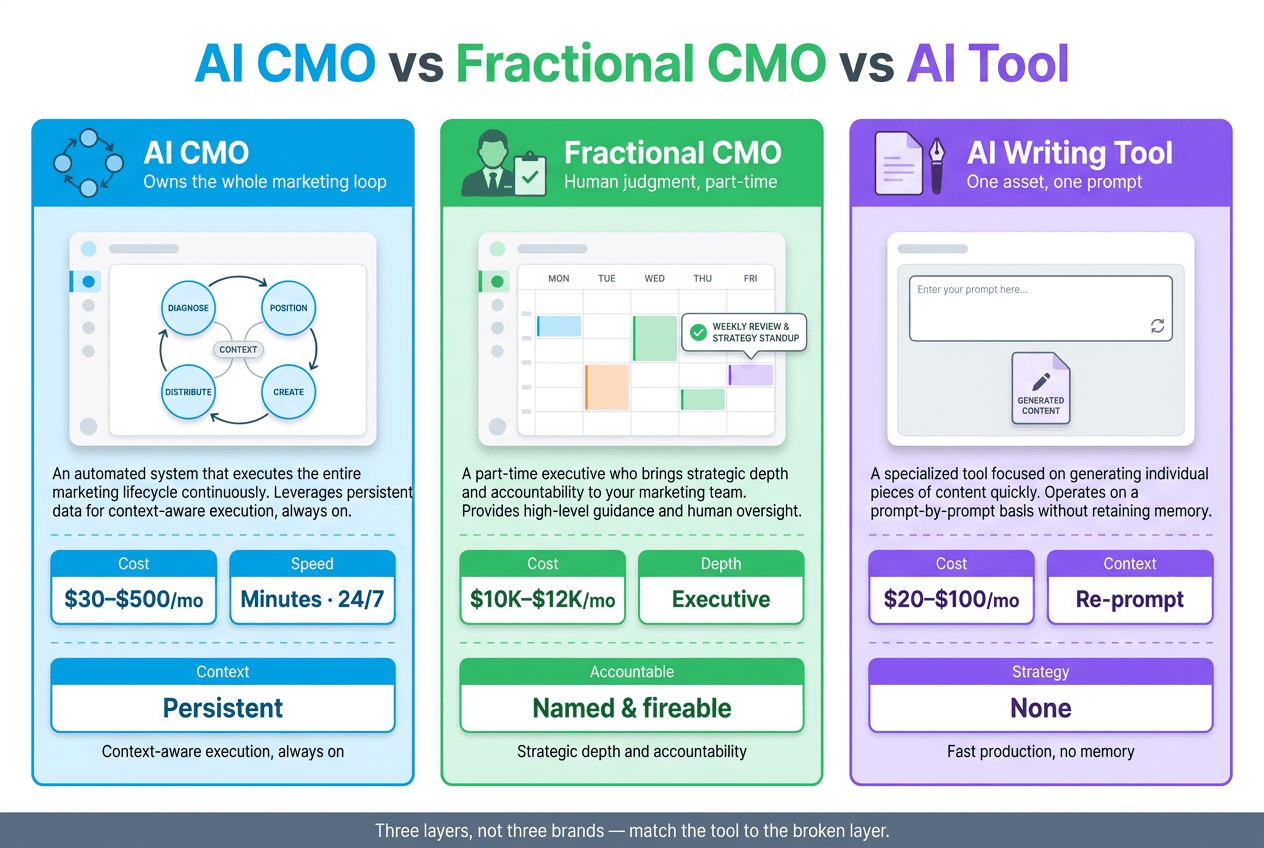
AI CMO vs fractional CMO vs AI writing tool: three layers, not three brands
The most expensive mistake small teams make is treating these three as competitors for the same slot. They're not. 94% of executives report no significant value from AI investments (McKinsey, 2025) — largely because they slotted a $40 writing tool where a strategy function belonged, then blamed the model. Each option sits on a different layer of the same stack.
A fractional CMO is the executive layer: a person in your leadership meeting deciding what to do and why. A generic AI tool is the production layer: a fast way to make one thing when you already know what to make. An AI CMO is the coordination layer in between — it turns a strategy into briefs, the briefs into assets, and the assets into a publishing schedule, against your stored context. Confuse the layers and you'll over-buy one while starving another.
Here's the head-to-head across the five dimensions that decide which line item earns its keep.
| Dimension | AI CMO | Fractional CMO (human) | Generic AI writing tool |
|---|---|---|---|
| Monthly cost | $30–$500 (subscription) | $5K–$20K (avg $10K–$12K) | $20–$100 per tool |
| Speed of output | Minutes — always on | Weekly cadence | Minutes — one task |
| Strategic depth | Medium — diagnoses & positions from your context | High — executive judgment | None — you supply the strategy |
| Accountability | Software SLA; the decision stays yours | Named, contractual, fireable | None |
| Persistent context | High — owns a brand model across channels | High — sits in your standups | Low — re-prompt every time |
Read that table by column, not by row. The human is the only one that owns accountability and top-tier judgment. The AI CMO is the only one that pairs low cost with persistent context and full-loop coverage. The generic tool is cheapest per seat and the most dangerous to mistake for a strategy. Which of the four CMO jobs does each actually cover? That's the picture below.
Cost: a CMO's judgment at a software line item?
Cost is the only dimension where the gap is two full orders of magnitude. Fractional CMO retainers run $5,000–$20,000 per month, with most engagements landing at $10,000–$12,000 (Growtal, 2026). AI CMO software sits at $30–$500 a month — the same shelf as a generic tool stack. So is the AI version just a cheaper CMO? Not exactly. It's a different thing at a cheaper price.
The honest framing is paid for what. A fractional CMO is paid for judgment — every bad campaign they kill is worth part of the retainer. An AI CMO is paid for context-aware throughput — it should ship the brief across every channel faster than your team can review it, without re-learning your business each time. A generic tool is paid by the seat and judges nothing. The danger isn't the price tag; it's paying tool prices and expecting executive outcomes.
For the full breakdown of what a human engagement actually buys at each tier, see our fractional CMO cost guide. The short version: a $10K retainer typically buys 10–20 hours a week — about two days of senior attention. An AI CMO buys throughput that doesn't clock out. They're not priced to be compared; they're priced to be combined or sequenced.
Persistent context: the thing that separates an AI CMO from a chatbot
This is the dimension that defines the entire category. Only 13% of marketers are using agentic AI today (Salesforce, 2026), which means most teams are still working with tools that forget their business the moment a session ends. Persistent context is the line between an AI CMO and a fast autocomplete — and it's the line most buyers don't know to look for.
Think about what a generic AI tool costs you in time, not money. Every task starts with re-explaining your product, ICP, competitors, and tone — call it 5 to 8 minutes per prompt. For an active small team running dozens of tasks a week, that re-prompting tax adds up to most of a working day, every week, spent telling the machine who you are. An AI CMO stores that understanding once and applies it everywhere, so the marginal cost of the next asset is close to zero and the output doesn't drift generic.
The defining feature of an AI CMO is persistent business context — a stored model of positioning, ICP, and voice applied across every channel automatically. Without it, you're paying a re-prompting tax of roughly 5–8 minutes per task. Only 13% of marketers use agentic AI (Salesforce, 2026), so for most teams this advantage is sitting unused in front of them.
A human fractional CMO still holds an edge on unwritten context — founder intuition, the campaign that flopped two years ago and why, the culture you can't put in a doc. But for documented context — positioning, ICP, voice, competitor set — the gap has closed faster than most teams realize.
Where a human fractional CMO still wins
Honesty matters more than the pitch here, so let's name where the human stays ahead: strategic depth and accountability. 60% of companies generate no material value from AI, and only 5% create substantial value at scale (BCG, 2025). For category creation, repositioning, and long-arc bets that contradict the obvious play, a human's judgment isn't replaceable by pattern-matching yet.
Accountability is the sharper edge. A fractional CMO has a name, a contract, and a quarterly review — if pipeline misses for two quarters, you have a hard conversation or you part ways. An AI CMO can produce a campaign that loses $15,000 in ad spend, and there's no equivalent recourse; you churn the subscription, but the decision was always yours.
The pattern we see in customer conversations is consistent: the small teams happiest with an AI CMO are the ones where a single person clearly owns "marketing" as a role and runs the system as a force multiplier. The frustrated teams are the ones where everyone owns marketing and no one does — they expected the software to supply accountability it structurally can't. The AI runs the loop; a human still has to own the number.

This is also why the AI-CMO-vs-human framing is rarely either/or in practice. The richer decision is the human-vs-stack one — when to buy judgment and when to buy capacity — which we cover in depth in fractional CMO vs AI. That sibling piece is the one to read if you're choosing between hiring a person and assembling a stack from scratch.
The 24/7 layer: what an AI CMO does that neither alternative does
There's one thing an AI CMO does that a human and a generic tool both structurally can't: run continuously. A fractional CMO caps at the 10–20 hours they sell; a generic tool only moves when you prompt it. An AI CMO can monitor, create, and distribute around the clock — and increasingly that matters, because the channels it feeds never close either. 78% of growing SMBs plan to increase AI investment (Salesforce, 2025), and always-on distribution is a large part of why.
What does 24/7 actually buy at a small company? Three things a weekly human cadence can't: distribution that keeps publishing while you sleep, monitoring that catches a competitor move or a brand mention the same day it happens, and the patience to maintain channels — like AI search visibility — that reward consistent presence over bursts. That last one is increasingly where the buying journey starts; our roundup of AI visibility tools covers the surface an always-on system is meant to defend.
Unlike a human fractional CMO capped at 10–20 hours a week, or a generic tool that only acts when prompted, an AI CMO runs continuously — distributing content, monitoring competitors, and maintaining presence across channels around the clock. With 78% of growing SMBs planning to increase AI investment (Salesforce, 2025), always-on execution is the capability driving the shift.
The caution: continuous output is only as good as the strategy steering it. An AI CMO running 24/7 on fuzzy positioning just produces more generic work, faster. The always-on layer compounds whatever direction you give it — which is exactly why the next section starts with positioning, not features.
AI CMO vs fractional CMO: when each is the right call
The call we'd make if a small team asked privately, pitch decks aside, comes down to one question: is your positioning sharp? Marketers utilize only 33% of their martech stack's capabilities, down from 58% in 2020 (Gartner via MarTech, 2024) — proof that more tooling rarely fixes a direction problem. So diagnose the layer that's actually broken before you buy anything.
Use an AI CMO when positioning is sharp, your ICP fits in two sentences, and execution velocity is the bottleneck. You don't need a human to type faster — you need a system that holds your context and ships across channels without re-briefing. This is the largest group of small teams, and the one most over-served by expensive retainers.
Hire a human fractional CMO when positioning is fuzzy, you've changed your ICP twice this year, or you've never run a serious go-to-market plan. Scope it as a finite two-quarter engagement with written deliverables — a positioning doc, an ICP profile, a 90-day plan — not an open-ended retainer. Then feed those documents into an AI CMO to execute.
Run both when you're past roughly $5M ARR with at least one in-house marketer. A full-time marketing leader costs $130K–$190K loaded (Glassdoor, 2025), so the bridge is often a human for judgment plus an AI CMO for throughput. Want to see what context-aware execution costs in practice? Our pricing lays it out, and how the system works shows the diagnose-position-create-distribute loop end to end.
Frequently asked questions
What is an AI CMO?
An AI CMO is a marketing system that owns the CMO job end to end — diagnose, position, create, and distribute — against a persistent model of your business, rather than a single-task tool you re-brief every time. It's a category, not a brand. With 75% of SMBs already experimenting with AI (Salesforce, 2025), the distinction that matters is whether the AI remembers your positioning between tasks or starts from zero.
Is an AI CMO better than a fractional CMO?
Neither is strictly better — they sit on different layers. A human wins on strategic depth and accountability; an AI CMO wins on cost, speed, and always-on execution. Since 60% of companies see no material value from AI (BCG, 2025), the deciding factor is usually whether your positioning is already sharp. Sharp positioning favors an AI CMO; fuzzy positioning favors hiring a human first.
How much does an AI CMO cost?
AI CMO software typically runs $30–$500 per month — the same band as a small tool stack, and roughly two orders of magnitude below a human fractional CMO, who averages $10K–$12K/month (Growtal, 2026). The real question isn't "how much" but "paid for what": a human is paid for judgment, an AI CMO for context-aware throughput.
Can an AI CMO replace a human CMO?
It replaces the execution and coordination layer beneath one, not the executive judgment on top. An AI CMO can diagnose, position, create, and distribute; it can't own the number in your board meeting. With only 13% of marketers using agentic AI (Salesforce, 2026), most teams haven't yet tested how far the execution layer reaches before a human call is required.
Is an AI CMO just ChatGPT with a marketing prompt?
No — that's the most common misconception. A generic AI tool produces one asset from one prompt, then forgets your business when the tab closes. An AI CMO keeps persistent context — positioning, ICP, voice — and applies it across channels without re-briefing. That persistence is the category line: 33% average martech utilization (Gartner, 2024) shows most teams never get value from tools that don't remember them.
The bottom line
The "AI CMO vs fractional CMO" question only sounds binary because the category is new enough that people reach for the nearest human comparison. The more useful map has three layers: a human for judgment and accountability, an AI CMO for context-aware execution across the whole loop, and a generic tool for one-off production. Most small teams need the middle layer and keep buying the bottom one.
The asset worth budgeting for at this size isn't a person or a tool — it's persistent context, the documented understanding of your business that any human or AI agent can pick up and run with. A human fractional CMO builds it in your standups. An AI CMO stores it and acts on it 24/7. A generic tool ignores it and asks again tomorrow. Decide which layer is broken in your business, then buy exactly that — and run a diagnosis before you spend a dollar more on tools that don't know who you are.