The best AI brand monitoring tools for ChatGPT (2026)
59% of Americans now use AI to research products. The best AI brand monitoring tools in 2026 to track your mentions, citations, and sentiment inside ChatGPT.

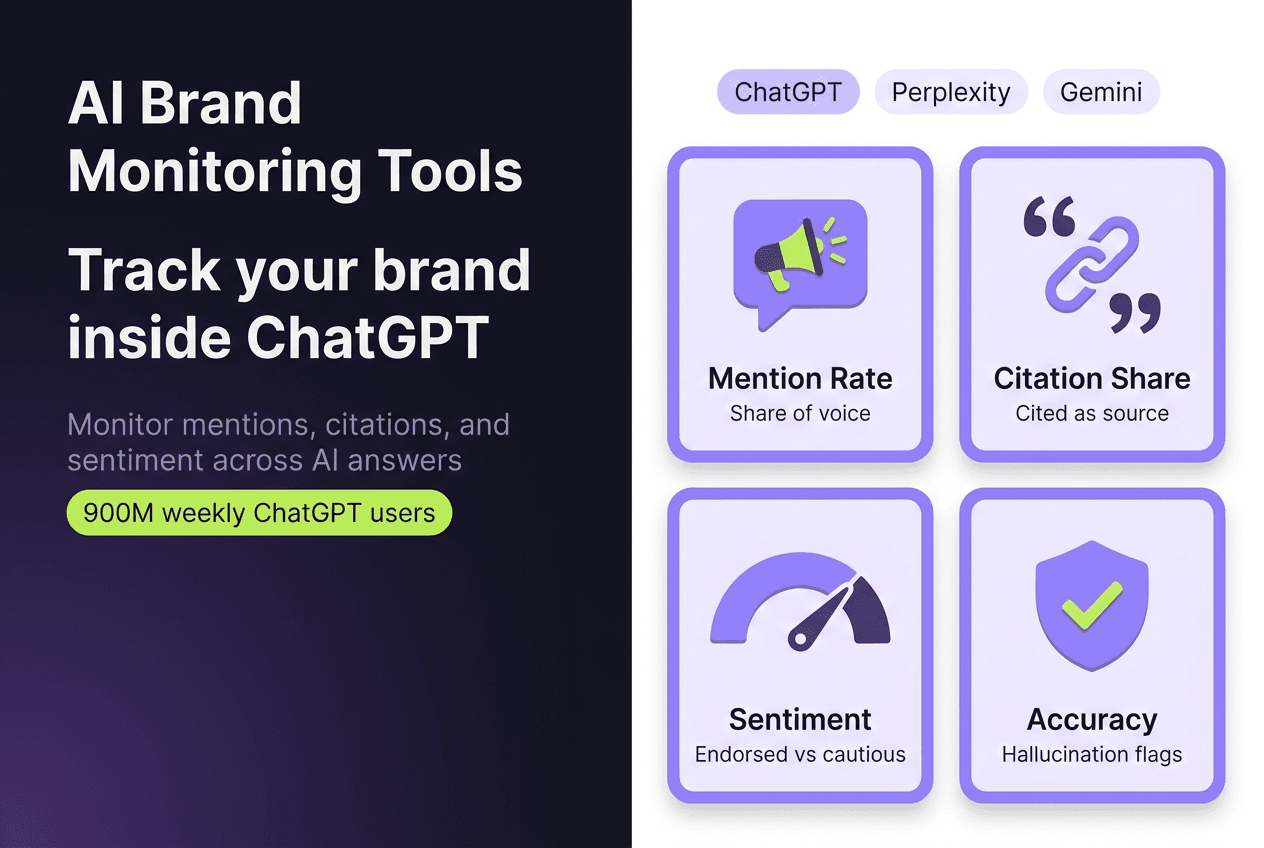
You can't see what ChatGPT tells 900 million people about your brand. There's no inbox for it, no mentions tab, no notification when a model summarizes your category and names three competitors instead of you. The conversation happens, a buying decision forms, and nothing reaches your analytics — because no link was ever clicked. ChatGPT crossed 900 million weekly active users by February 2026 (OpenAI via TechCrunch, 2026), and a growing share of them ask it about products before they ask anyone else.
That blind spot is what AI brand monitoring tools exist to close. They turn the invisible — what AI says about you, to whom, and in what tone — into something you can actually watch. This guide defines the category, breaks down the four things a monitor should track, and ranks the best AI brand monitoring tools in 2026 by who they're built for.
Key takeaways
- AI brand monitoring tools track how your brand is mentioned, cited, and characterized inside AI answers — not what people post about you, but what the model itself says.
- The stakes are real: 59% of Americans now use generative AI to shop, and 1 in 4 say ChatGPT beats Google for product research (Omnisend/Cint, 2025).
- Presence isn't the hard part — sentiment is. Across 200+ brands, the average brand was endorsed on only 28% of category prompts where it appeared (Visiblie, 2026).
- Tools split by buyer: enterprise depth (Profound), mid-market AI-native (Peec, Scrunch), budget (Otterly, Knowatoa), and the monitor-plus-fix lane (Sivon). Start with a free audit before you subscribe.
What are AI brand monitoring tools?
AI brand monitoring tools track how your brand shows up inside AI-generated answers — across ChatGPT, Perplexity, Gemini, and Google's AI Overviews. They run a defined set of prompts on a schedule, then report whether you're named, whether you're cited as a source, how often, and in what tone. Think of it as media monitoring for a channel where the "coverage" is a sentence a model writes fresh each time, and never files anywhere you can search.
Why is this its own category and not just a social-listening feature? Because the thing being watched is different in kind. Social listening finds posts that already exist; AI monitoring watches an answer that doesn't exist until someone asks. The audience is also enormous and intent-rich: 59% of Americans now use generative AI tools for online shopping, and 25% say ChatGPT beats Google for product research (Omnisend/Cint, n=1,224, 2025). When a quarter of shoppers trust a chatbot over Google for research, what that chatbot says about you is brand-critical.

The scale of the surface is the reason this can't stay a manual spot-check. ChatGPT went from 400 million weekly users in February 2025 to 800 million by October to 900 million by February 2026 — more than doubling in a year.
For the wider category these monitors belong to — the trackers, auditors, and optimizers around them — our guide to the best AI visibility tools maps the full field.
Why monitor your brand inside AI answers?
Because being mentioned isn't the same as being recommended, and the gap between them is where deals are won or lost. Presence is the easy metric — most established brands get named eventually. The harder, more valuable question is how you're named. Across 200+ brands tracked by one monitoring platform, the average brand was endorsed on just 28% of category prompts where it appeared, with 41% neutral, 19% cautious, and 12% containing outright hallucinations (Visiblie, 2026). You can be highly visible and quietly damaged at the same time.
That sentiment split is the case for monitoring in one picture. A neutral mention does little; a cautious one ("some users report issues") actively steers buyers away; a hallucinated claim invents a flaw you don't have. None of it shows up in Google Analytics, and none of it gets corrected unless you're watching.
The discovery shift makes the timing urgent. Bain's 2025 analysis found ChatGPT's shopping-related queries doubled in six months, with click-throughs to brands rising from a 2.2% to a 5.7% rate (Bain & Company, 2025). Buyers are moving into the answer box, and the brands that monitor what they find there get to shape it. The ones that don't are guessing. If you want the underlying mechanics of why a model picks one brand over another, our generative engine optimization primer and the Perplexity SEO guide cover the levers these monitors only measure.
What should an AI brand monitoring tool track?
A monitor earns its subscription on four metrics, not one. Tracking only "are we mentioned?" is the rookie mistake — it tells you the model knows you exist and nothing about whether that helps. 93% of Google AI Mode answers now end without a click (Semrush, 2025), so the answer is the impression. What it contains about you is the whole game. Here's what a serious tool should report.
- Mention rate / share of voice — how often you're named on your category prompts, and how that compares to competitors. This is presence, the floor metric.
- Citation share — when the model cites sources, is yours one of them? Citation is stronger than a passing mention; it's the model vouching for you as the reference.
- Sentiment — endorsed, neutral, cautious, or negative. As the data above shows, this is where most of the risk and most of the upside live.
- Accuracy / hallucination flags — is the model stating things about you that are simply wrong? A fabricated limitation or an outdated price is a brand-safety problem you can only fix once you've spotted it.
The fifth thing worth watching is drift. AI answers are non-deterministic — ask twice, get two slightly different responses — so a single snapshot tells you almost nothing. A tool that reports one fixed "score" without trending it over repeated runs is flattening a moving target into a number that feels precise and isn't.
What are the best AI brand monitoring tools in 2026?
The best AI brand monitoring tools in 2026 sort by buyer, not by feature count — the right pick depends on whether you need enterprise depth, mid-market sentiment tracking, a cheap first look, or a monitor that also fixes what it finds. Investors are treating the category as permanent: Profound raised $96M at a $1B valuation in February 2026, with 700+ enterprise customers (SiliconANGLE, 2026). Any of these beats flying blind; the question is fit.

| Tool | Best for | What it monitors | Platforms | Entry price (2026)* |
|---|---|---|---|---|
| Profound | Enterprise depth | Mentions, sentiment, source breakdown, agent traffic | ChatGPT, Perplexity, Gemini, AIO + more | ~$499/mo |
| Peec AI | Mid-market teams | Visibility share, position, sentiment, competitors | ChatGPT, Perplexity, Gemini, AIO | ~€89/mo |
| Scrunch AI | AI-native brand presence | Mentions, accuracy, competitor share | Major LLMs | Mid-tier |
| Otterly.ai | Budget starters | Mentions + prompt monitoring, GEO audit | 6 platforms incl. AI Mode, Copilot | ~$29/mo |
| Knowatoa | SMB first look | Mentions, daily refresh, free initial audit | Major LLMs | ~$59/mo |
| Brandwatch / Meltwater | Teams already on social listening | Social + AI answers (retrofitted) | Social-first, adding AI | Enterprise |
| Sivon | Teams that want to act | Mentions, citations, competitors via Pulse | Audit + Pulse monitoring | In-platform |
*Entry pricing per vendor sites and 2026 roundups; verify current rates before buying.
Enterprise: Profound. It's the depth reference — it breaks down how AI engines build answers, which sources they pull, and increasingly how AI agents (not just people) encounter your brand. At ~$499/mo it assumes you have an analyst to act on the output. Overkill for a five-person team; right for a category leader defending share.
Mid-market AI-native: Peec AI and Scrunch. This tier is the sweet spot for most marketing teams. Peec AI (~€89/mo) tracks visibility share, position, and sentiment, then recommends content changes to lift your citation rate. Scrunch leans into the agent era, watching presence and factual accuracy across models. If you want sentiment and competitor context without an enterprise contract, start here.
Budget and SMB: Otterly and Knowatoa. Otterly.ai punches above its ~$29/mo price with six-platform coverage and a built-in GEO audit. Knowatoa offers a free initial audit and daily refresh near $59/mo. For a first 90 days, either answers the only question that matters early: are we even in the conversation?
The social-listening crossover: Brandwatch and Meltwater. The legacy listening incumbents are extending into AI answers, which is convenient if you already pay for one. Be honest about the trade-off, though — they were built to find existing posts, and the generated-answer surface is a retrofit, not their native home. For a closer look at how the rank-tracker-style tools differ from these monitors, our LLM SEO tools breakdown splits the adjacent lane, and our ChatGPT SEO tracking tools guide covers the ChatGPT-specific trackers.
How do you monitor brand visibility in AI interfaces like ChatGPT?
Monitoring brand visibility in AI interfaces like ChatGPT means running a fixed prompt set through the model on a schedule and recording how you show up each time — named or not, cited or not, framed well or badly. ChatGPT is where you start because it dominates the channel: 87.4% of AI referral traffic comes from ChatGPT alone (Similarweb, 2025). A monitoring tool automates the sampling so you're trending behavior, not eyeballing it once.

The manual version is simple enough to try this afternoon: list 15–20 prompts a real buyer would type ("best [your category] tool," "[competitor] alternatives," "is [your brand] any good?"), run them in ChatGPT, and log who gets named, who gets cited, and the tone toward you. Repeat weekly. The catch is what you'll notice on run two.
Our read: when we pointed Sivon's own Pulse monitoring at ourselves, the surprise wasn't the citation rate — it was the instability. A prompt that named us on Monday dropped us by Thursday with no change on our end. That week-to-week drift is the real argument for automated monitoring over a one-time check: a single snapshot of a non-deterministic system tells you almost nothing about the trend.
For the same exercise across the other engines, our guide to ranking in ChatGPT covers the on-page work that moves these numbers — monitoring tells you where you stand, but the fix is a separate job. Which is exactly the gap worth naming before you buy.
Where Sivon fits: monitoring that closes the loop
Most AI brand monitoring tools stop at the alert. They tell you you're under-cited, or that a model is framing you badly, and then the dashboard's work is done and yours begins — usually in a separate content tool you have to wire up yourself. Sivon sits deliberately on both sides of that line. Pulse monitors your mentions, citations, and competitors across AI surfaces. The AI Visibility audit scores how citable your brand actually is. Then the content engines draft the structured, quotable pages that earn the citation — written against your Brand Blueprint, so the fix sounds like you, not like generic AI.
The split worth naming is detection versus correction. A pure monitor is a very precise way to watch yourself lose; it raises the alarm but hands you no remedy. Sivon is built so the finding becomes a shipped page in one system. It won't out-monitor Profound on raw prompt-set depth — that's not the bet. The bet is that a small team wants the problem and the fix in the same place, not a monitoring subscription that just makes the bad news arrive faster.
Sivon's Pulse monitoring closes the loop: it watches how AI describes you, the audit scores your citability, and the engines publish the structured content that improves it — all against your Brand Blueprint. To see the full category these monitors sit inside, our best AI visibility tools guide ranks trackers, auditors, and optimizers side by side.
Whichever tool you choose, pair monitoring with a publishing motion. Watching your sentiment slide without the means to act on it is the most expensive form of awareness there is. If you'd rather see where you stand and fix it in one place, start with Sivon's AI Visibility audit — then layer a dedicated monitor on top only if the depth earns it.
Frequently asked questions
What are AI brand monitoring tools?
AI brand monitoring tools track how your brand is mentioned, cited, and described inside AI-generated answers — ChatGPT, Perplexity, Gemini, and Google AI Overviews. Instead of social posts, they watch generated responses, reporting mention rate, citation share, sentiment, and factual accuracy. The surface is large: ChatGPT reached 900 million weekly active users by February 2026 (OpenAI, 2026).
How do I monitor brand visibility in AI interfaces like ChatGPT?
Run a fixed set of category prompts through ChatGPT on a schedule and record whether you're named, cited, and how you're framed. A monitoring tool automates that sampling and trends it. Manual spot-checks miss drift — a brand named on Monday can vanish by Thursday with no site change, so repeated automated sampling beats a one-time look at a non-deterministic system.
Can AI brand monitoring tools track Perplexity and Gemini too?
Yes. The better tools watch the full surface — ChatGPT, Perplexity, Gemini, Copilot, and Google AI Overviews — because behavior is fragmenting fast. ChatGPT drives 87.4% of AI referral traffic (Similarweb, 2025), but the other engines grow at different rates, so single-platform monitoring leaves most of the map dark.
What's the difference between AI brand monitoring and social listening?
Social listening tracks what people say about you on social platforms; AI brand monitoring tracks what the model says about you in a generated answer. Legacy listening tools like Brandwatch and Meltwater are retrofitting AI coverage, but AI-native monitors were built for the generated-answer surface — where there's no post to find, only a sentence a model produces on demand.
How much do AI brand monitoring tools cost?
Budget monitors start around $29–59/mo (Otterly near $29/mo, Knowatoa near $59/mo with a free initial audit, per vendor sites, 2026). Mid-market AI-native tools run roughly €89/mo (Peec AI), and enterprise platforms like Profound sit near $499/mo. Start with a free audit to confirm a gap before committing.
The bottom line
AI brand monitoring tools make a hidden channel visible — and in 2026, with 900 million people asking ChatGPT and 59% of Americans using AI to shop, that channel is no longer optional to watch. But monitoring is half the job. The brands that win the AI answer aren't the ones whose dashboards blink hardest; they're the ones who catch a cautious mention or a hallucinated flaw and fix it before it costs a sale.
Pick your monitor by buyer-fit — enterprise depth, mid-market sentiment, or a cheap first look — and start with an audit to confirm there's a gap worth chasing. Then wire it to a publishing motion, so detection turns into correction. Run Sivon's AI Visibility audit and get the finding and the fix in one place.