Content marketing automation: a guide for small teams
85% of marketers now use AI to write content, yet 81% of teams still ship off-brand work. Here's how small teams automate content that sounds like them.


Every small marketing team eventually has the same week. You adopt AI to keep up. You write faster. Then you spend the time you saved fixing the tone, re-pasting your positioning into the next prompt, and quietly rewriting output that could belong to any company in your category.
Speed was never the bottleneck. On-brand speed was — and that's the real test of content marketing automation, not how fast it can fill a page.
That gap shows up in the data. 85% of marketers already use AI writing or content tools (CoSchedule, survey of 1,005 marketers, 2024). Generation is effectively solved. Yet 81% of companies still produce off-brand content despite having brand guidelines (Lucidpress State of Brand Consistency, 2019). More output, same drift.
This guide maps what a small team can actually automate, what should stay human, and the one variable that decides whether automation helps or quietly erodes your brand. We run our own content this way — including StatusLink, one of our own products — so the screenshots below are the real workflow, not a mockup.
Key takeaways
- 85% of marketers use AI to create content, but 81% of companies still ship off-brand work (CoSchedule, 2024; Lucidpress) — the problem isn't speed, it's consistency.
- Automate the repeatable work (drafting from a brief, repurposing, scheduling); keep strategy and final judgment human.
- Generic AI is trained on the average of the internet, so it sounds generic by default. Automation only stays on-brand when the system carries your business context into every output.
- The highest-leverage play for a small team is repurposing: one well-made asset becomes a week of channel-native posts.
What is content marketing automation?
Content marketing automation is the practice of running your full content lifecycle — ideation, creation, repurposing, distribution, and measurement — through repeatable workflows instead of manual handoffs. Most businesses now run some form of marketing automation, and small and mid-sized firms are its fastest-growing segment — the SME market is on a 15%+ annual growth track through 2030 (Grand View Research, 2024).
The word people trip on is "automation." It doesn't mean a robot writes your blog while you sleep. It means the steps that don't need your judgment — pulling a brief into a first draft, reshaping a post for a second channel, queueing it to publish — stop eating your calendar.
It's worth separating two things that get blurred. An AI writer is a single box you paste a prompt into. Content marketing automation is the workflow around that generation: the brief that feeds it, the brand context that shapes it, and the distribution that follows. One is a tool. The other is a system.
Content marketing automation runs the content lifecycle through repeatable workflows rather than manual handoffs. It is distinct from a standalone AI writer in that automation includes the brief, the brand context, and the distribution around generation. Most businesses now run some form of it, and small and mid-sized firms are its fastest-growing adopters (Grand View Research, 2024).
For a small team, the appeal is obvious. The risk is just as obvious, and almost nobody writing about this topic will say it out loud.
Why does automated content all sound the same?
Because generic AI is trained on the average of the internet, so its default output reads like everyone else's (CXL, 2025). The model has no idea who you are. It returns the statistical middle of every blog post ever written on your topic: competent, fluent, and completely interchangeable.
Now layer in how most teams actually use it. 95% of organizations have brand guidelines, but only about 25-30% actively use them (Renderforest, 2024). 60% of marketing materials don't conform to the brand guide at all (Demand Metric). So the guidelines exist in a Google Doc nobody opens, while the AI runs on its generic default. (If yours are the problem, here's how to write brand guidelines that actually get used, anchored by a documented brand voice.) The result is the 81% off-brand figure: automation pouring fuel on a consistency problem that predates it.
Does any of this matter commercially, or is it a vanity concern? It matters. A consistent brand voice is associated with revenue increases of 23-33% (Lucidpress / Demand Metric), and 45% of consumers question a brand's authenticity when its messaging is inconsistent (Renderforest, 2024). Generic content isn't just bland. It costs you the recognition you spent years building.
What should a small team automate — and what should stay human?
Automate the repeatable, judgment-light work; keep strategy and final editorial judgment human. The practical line: if a task is the same every time and only needs your taste at the end, automate it. If it sets direction or makes a positioning call, it stays with you. Done right, automation lets one person produce at the volume of three or four (monday.com, 2026) — the operating logic behind the marketing team of one model.
Start by writing down your content process, step by step, and timing each one. Most small teams find the same culprits: keyword research, turning a brief into a first draft, reshaping a post for social, and scheduling. If research takes two hours an article and you publish ten a month, that's twenty hours. Add an hour of social reshaping per piece and you're near a full work-week, every month, spent on motion rather than judgment.
Here's the split that holds up:
- Automate: first drafts from a brief, repurposing one asset into other formats, scheduling, distribution to owned channels, and routine refreshes of older posts.
- Keep human: strategy, positioning, the angle, which bets to make this quarter, and the final read before anything ships.
The rule for a small team: automate tasks that are identical every time and only need your taste at the end; keep anything that sets direction. Used this way, marketing automation lets one person operate at the output of three or four (monday.com, 2026) — without handing strategy to a model.
Notice what's not on the automate list: the thinking. That's the part the rest of this guide protects.
How do you automate long-form content without losing your voice?
You feed the system your brand context before it writes a word, not after. Long-form is where generic AI fails most visibly, because length exposes tone. A 1,800-word post written from a blank prompt drifts into the internet-average voice by paragraph three. The fix is to start every draft from your positioning, audience, and tone, so the output begins on-brand instead of getting edited toward it.
This is the work StatusLink — our own product — runs through Content Studio. The brand context lives in one place and feeds the draft, so a 1,800-word guide comes out scoring well on structure and keywords and sounding like StatusLink, not like a template.
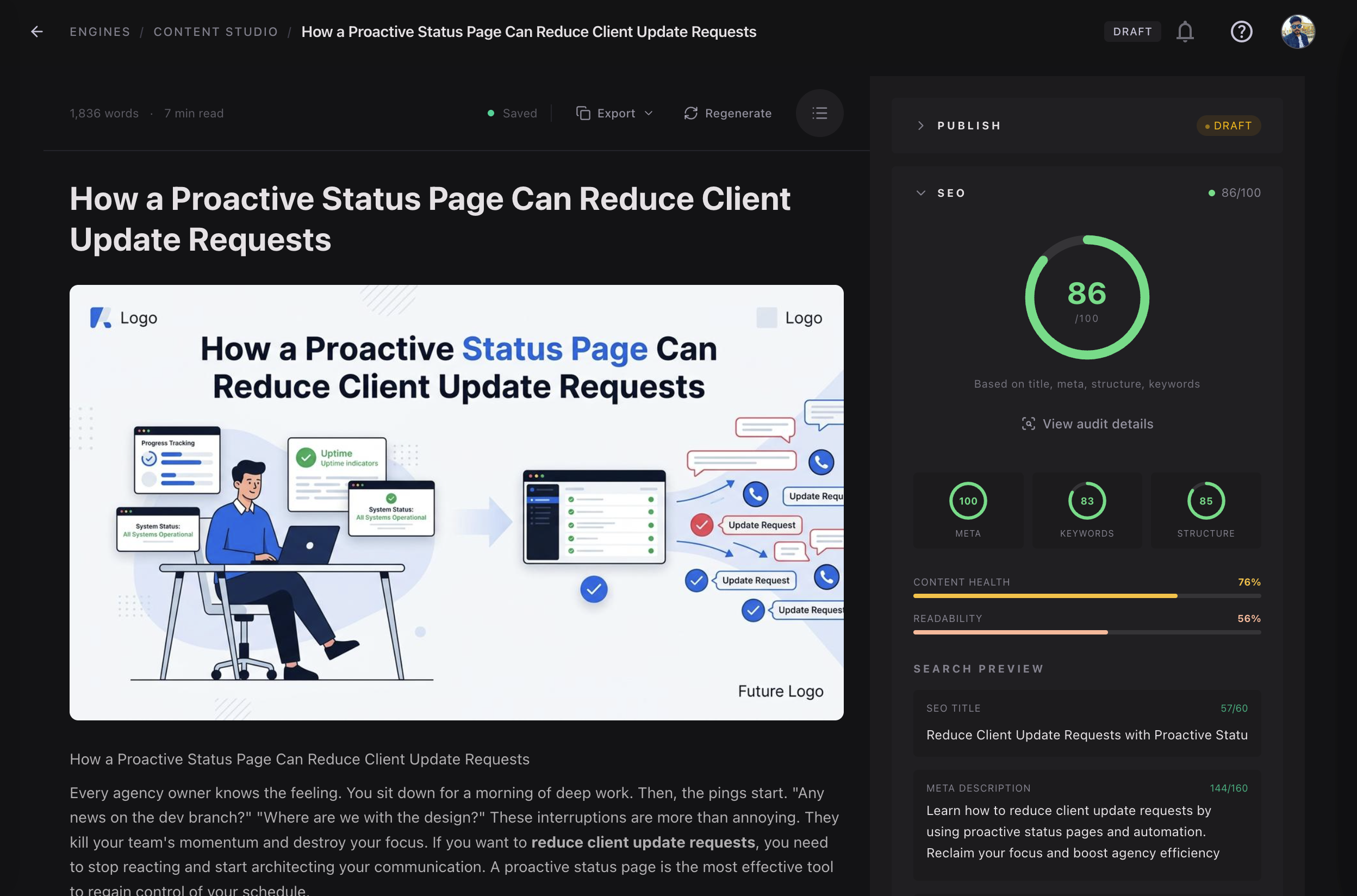
The deeper mechanics of long-form automation — how to structure a brief the system can actually use, where to keep a human in the loop, and how to avoid the "edit everything anyway" trap — deserve their own walkthrough, which we'll publish as a follow-up.
How do you keep social content flowing without the calendar grind?
By generating posts one at a time from the same brand context, instead of bulk-dumping a month of generic captions you'll never use. Social punishes generic content faster than any channel. A flat, on-the-nose post just gets scrolled past. The teams that stay consistent aren't the ones with the biggest content calendars. They're the ones who can produce a good, on-brand post in minutes when an idea lands.
That's the philosophy behind how we approach social: suggest angles, then generate the specific post you want, shaped by the brand voice already on file. No re-explaining the product. No generic hashtag soup. The same StatusLink context that wrote the blog also writes the LinkedIn and X versions.
The social teams that stay consistent aren't the ones planning the most posts in advance. They're the ones who can produce one good, on-brand post quickly when an idea is fresh — because the brand context is already loaded, not re-typed into every prompt.
How to build a repeatable social rhythm that doesn't depend on a rigid calendar is its own topic — one we'll cover in a dedicated follow-up.
How do you turn one blog post into a week of social content?
Repurposing is the single highest-leverage automation for a small team: one well-made asset becomes a week of channel-native posts. You already did the hard thinking when you wrote the long-form piece. Repurposing extracts that thinking into formats each platform actually rewards: not the same text pasted everywhere, but a LinkedIn take, an X thread, a visual tweet, each shaped for its channel.
This is where automation stops being four disconnected tools and starts being one system. The StatusLink article above flows straight into social: same brand context, different format. The post below — a "Fatal UX vs Strategic Result" visual tweet — came out of the same source material that produced the blog, not a separate brief written from scratch.
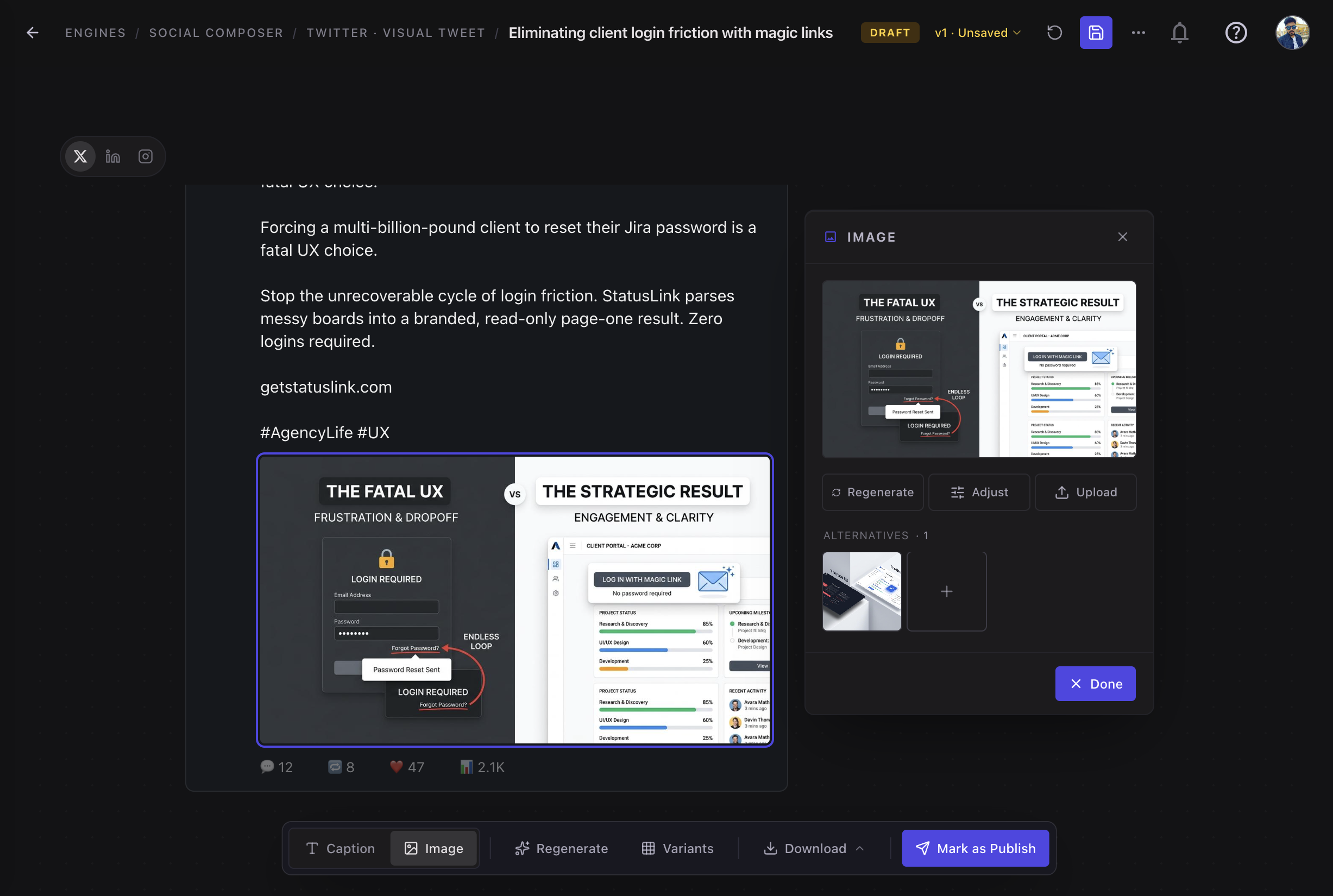
Why does this matter so much for a 2-3 person team? Because it inverts the math. Instead of one piece of content per unit of effort, you get five or six, and they reinforce each other across channels. A full walkthrough of the blog-to-social repurpose flow is worth its own piece, which we'll publish next.
Why does persistent brand context beat a generic AI writer?
Because the difference between automation that helps and automation that drifts is whether the system remembers your business between outputs. A generic AI writer starts from zero every session. You re-explain your product, your audience, and your tone, then do it again on the next post. That re-explaining is the hidden cost nobody prices in.
The structural problem is widespread. Only 23.3% of companies have AI integrated into their stack; 76.7% run it as disconnected tools that don't share context (MarTech, 2025). Disconnected tools are exactly why automated content reads generic and inconsistent. Each one is guessing, alone, with no memory of the others.
The alternative is to set your context once and apply it everywhere. That's what a brand profile does: positioning, values, audience, palette, and tone live in one place and shape every output, across every channel. Here's StatusLink's, the same profile feeding the blog and social you saw above.
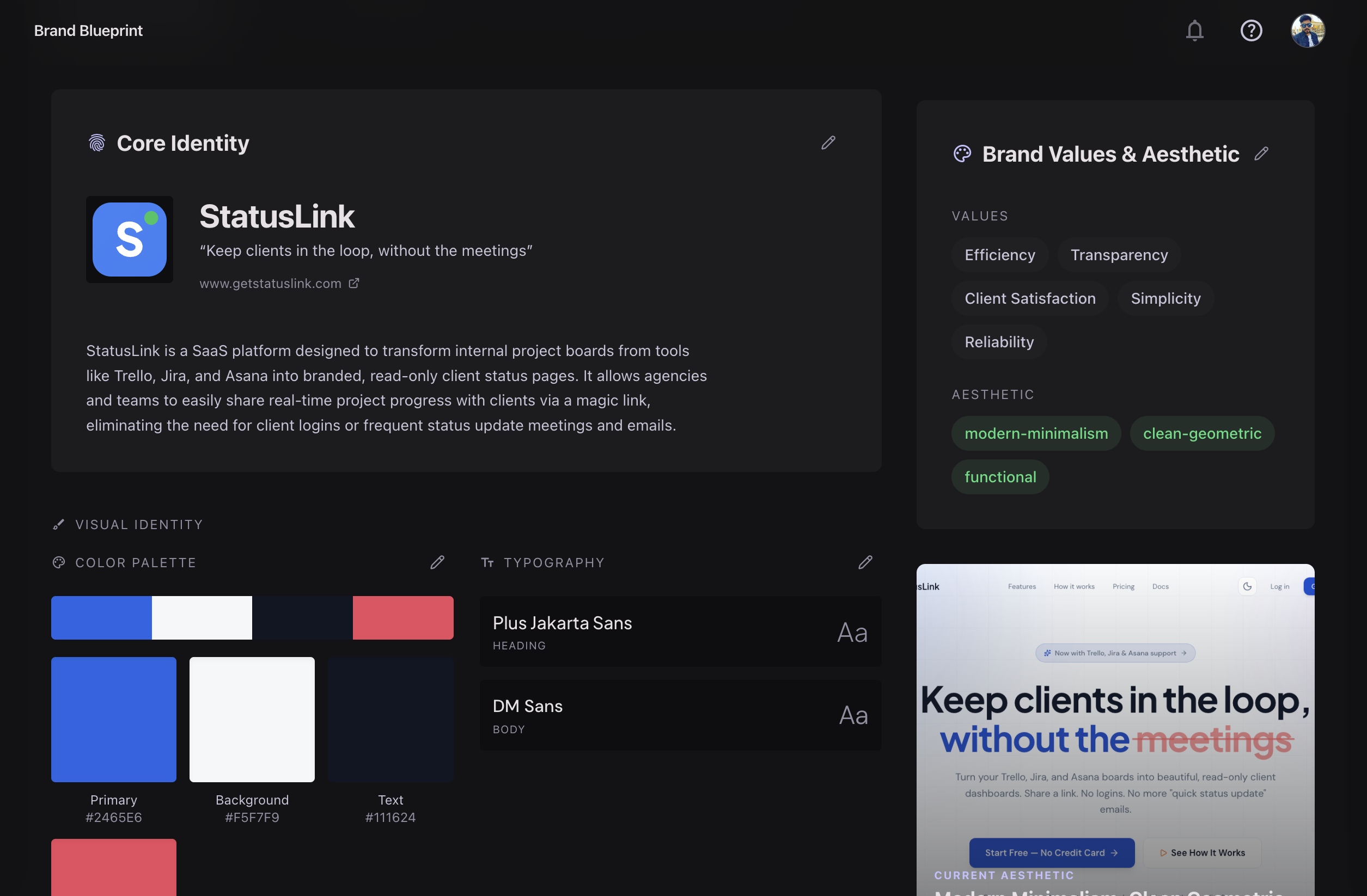
Our test (to run): Generate the same post twice — once from a blank prompt, once from a stored brand profile — and score both against your voice guide. We're running this on StatusLink now and will publish the numbers. The point isn't speed. Both drafts arrive in seconds. It's how much editing each one needs before it sounds like us.
The reframe worth sitting with: the bottleneck for a small team was never writing speed. It's the context tax: the minutes you spend re-explaining your business to a tool that forgets, multiplied by every post, every week.
Automation examples small teams can copy
The most useful automations are unglamorous and repeatable. Below are plays a small team can put in place without a big budget or a martech specialist — each paired with the on-brand caveat that makes it work.
- Brief-to-draft. Turn a one-paragraph brief into a structured first draft from your brand context. Caveat: the brief sets the angle; the system fills the structure.
- The repurposing engine. One blog post becomes a LinkedIn post, an X thread, and a newsletter section. Caveat: reshape per channel, don't paste the same text.
- One source, many formats. A customer interview becomes a case-study outline, three social quotes, and an FAQ entry. Caveat: keep the real quotes verbatim.
- Owned-channel distribution. Auto-queue approved posts to your scheduler so publishing isn't a manual ritual. Caveat: approval stays human.
- The refresh cadence. Flag posts older than six months for a data-and-link update. Caveat: update the facts, not just the date.
- The Monday brief. Auto-synthesize last week's activity into a short plan for the week ahead. Caveat: you choose the priorities; it assembles the inputs.
None of these replace a marketer. They remove the motion around the marketing so the small team spends its hours on judgment.
Is content marketing automation worth it for a small team?
For most small teams, yes — provided it stays on-brand. The return on content is strong on its own: content marketing is widely cited as returning around $3 per $1 spent versus roughly $1.80 for paid advertising, and marketing automation specifically returns an average of $5.44 for every $1 spent over the first three years, with payback in under six months (Nucleus Research).
The honest counter matters more than the headline number. Automation only returns those multiples if the output is on-brand and the tools share context. Bolt a generic AI writer onto a small team and you can add cost: the cleanup, the rewrites, the slow erosion of a voice you worked to build. The math flips on whether the system remembers your business or makes you re-explain it.
So the real question isn't "should we automate content?" It's "will our automation stay on-brand without a full-time editor babysitting it?" That depends entirely on context, which is why the buying decision — and the timing of it — deserves care. For where automation fits in a lean tool budget and when to actually pay for it, see our guide on the marketing stack for a small team.
Frequently asked questions
What is content marketing automation?
Content marketing automation means running your content lifecycle — ideation, creation, repurposing, distribution, and measurement — through repeatable workflows instead of manual handoffs. Most businesses now run some form of marketing automation, and small and mid-sized firms are its fastest-growing segment (Grand View Research, 2024). It's a system around generation, not a single AI writing box.
What can a small team actually automate in content marketing?
Automate the repeatable, judgment-light work: drafting from a brief, repurposing one asset into many formats, scheduling, and distribution. Keep strategy, positioning, and the final editorial read human. Done well, automation lets one person produce at the volume of three or four (monday.com, 2026).
How is content marketing automation different from an AI writer like Jasper or Copy.ai?
A generic AI writer generates from a blank prompt and forgets your business between sessions. Content marketing automation built on persistent context keeps your positioning, ICP, and tone in every output. That difference is measurable: 81% of companies ship off-brand content despite having guidelines (Lucidpress).
Will automated content hurt my brand voice?
Only without persistent context. Generic AI is trained on the average of the internet, so its default output sounds like everyone else's. 95% of organizations have brand guidelines but only about 25-30% actively use them (Renderforest, 2024). The fix is feeding your context in, not writing slower.
Is content marketing automation worth it for a 2-3 person team?
For most small teams, yes — if it stays on-brand. Content marketing is widely cited as returning about $3 per $1 spent versus $1.80 for paid, and marketing automation returns an average of $5.44 per $1 over three years (Nucleus Research) — but the larger payoff is reclaimed time. The trap is a generic AI writer that adds cleanup work instead of removing it. See our marketing team of one guide for the operating model.
The next step
Automation isn't the hard part. Most teams can schedule and generate today. The hard part is keeping every output sounding like you while you move faster, and that comes down to whether your tools remember your business or make you re-explain it on every post.
That's the whole idea behind setting a brand profile once and applying it across content, social, and the rest. If you want to see how a single source of brand context flows into long-form, social, and repurposing without re-prompting, start with the Sivon engines. And if you're still deciding what to ship each week before you automate how, the small-team marketing playbook is the companion read.
A small team's edge was never producing more content. It's producing content that unmistakably sounds like you, at a pace one or two people can actually keep.