Brand voice guidelines: a practical framework with examples
95% of teams have brand guidelines; only 30% use them. A practical brand voice framework, a voice chart, and real before/after examples.

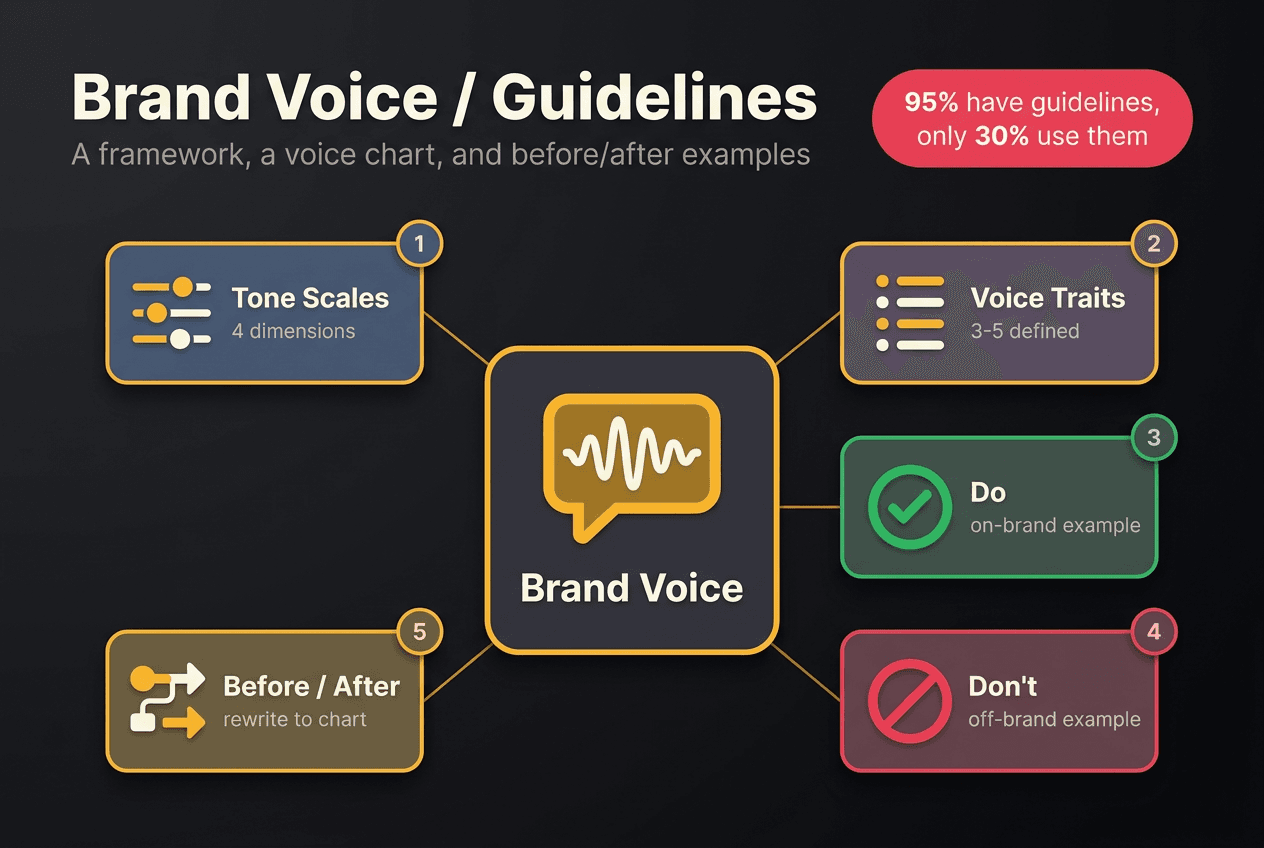
Most brand voice guidelines die in a slide deck. Someone picks three adjectives — "bold, human, approachable" — drops them in a doc, and the team never opens it again. Everyone keeps writing in their own voice. And the AI tool you just adopted writes in nobody's.
The cost is real, and it's measurable. Tone of voice changes how much people trust a brand and want to buy from it: in Nielsen Norman Group research, trustworthiness explained 52% of the variation in whether someone would recommend a brand (NN/g, n=100, 2024). Voice isn't decoration. It's a trust lever.
So why does almost nobody use their own guidelines? Because most of them aren't written to be used. This guide fixes that: a four-dimension voice framework, a voice chart with do/don't examples, real before-and-after rewrites, and how to hold the line across a team — and across the AI tools now drafting half your content.
Key takeaways
- Tone measurably drives trust — trustworthiness explained 52% of the variation in brand recommendation (NN/g, 2024). Voice is a business lever, not a style preference.
- Define voice on four scales (funny–serious, formal–casual, respectful–irreverent, enthusiastic–matter-of-fact), then turn each into a trait with a do and a don't.
- The most useful artifact is a one-page voice chart, not a brand bible. 95% of teams have guidelines but only ~30% use them (Renderforest, 2024).
- Voice only holds across a team and across AI when it lives as persistent context the tools read on every generation — not a doc nobody opens.
What are brand voice guidelines?
Brand voice guidelines are a short, usable document that defines how your brand sounds — its personality, tone, and the specific words it does and doesn't use. The good ones are operational: a handful of voice traits paired with do/don't examples, so any writer (or any AI) can produce copy that sounds like you. The bad ones are decorative — adjectives with no rules attached.
Here's the gap that makes this worth getting right. 95% of organizations have brand guidelines, but only about 30% use them regularly (Renderforest, 2024). The documents exist. They just don't change what gets written, because they're vague, long, or buried.
The reason is simple, and almost nobody says it: most guidelines describe a feeling, not a behavior. "We're confident and human" tells you nothing about whether to write "utilize" or "use." A real brand voice guideline is closer to a set of parameters than a mood board — concrete enough that two different people, or a person and a model, land on the same sentence.
Brand voice guidelines define how a brand sounds across every channel: its personality, its tone, and its specific word choices. The most effective versions pair three to five voice traits with do/don't examples. This matters because tone drives trust — NN/g research found trustworthiness explained 52% of the variation in whether users would recommend a brand (NN/g, 2024).
This is one spoke of a larger system. If you want the full picture — positioning, audience, and voice in one place — start with our Brand Blueprint template, the hub this guide sits under.
Brand voice vs. tone of voice: what's the difference?
Voice is constant; tone shifts with context. Your brand voice is the fixed personality behind everything you publish — it doesn't change between a product launch and an outage apology. Tone is how that voice flexes to fit the moment: warmer in a welcome email, more serious in a billing notice. NN/g found that casual, conversational, moderately enthusiastic tones performed best across banking, insurance, healthcare, and security sites (NN/g, 2024) — but the right tone is always situational.
A useful way to hold the distinction: voice is who you are, tone is how you read the room. You define voice once. You adjust tone every time you write. Most "tone of voice guidelines" actually need to cover both — the stable personality and the rules for flexing it.
That's why a single set of adjectives isn't enough. You need the trait and the range it's allowed to move within. Which brings us to the framework.
The four-dimension brand voice framework
The cleanest way to define a brand voice is to place it on four scales, a model NN/g has tracked since 2016: funny vs. serious, formal vs. casual, respectful vs. irreverent, and enthusiastic vs. matter-of-fact (NN/g, 2024). Each is a slider, not a switch — your brand can sit anywhere along it, including the middle.
Why four dimensions instead of a list of adjectives? Because scales force a decision. "Friendly" is a wish. "Two-thirds toward casual, but never irreverent" is a position you can write to. It also makes voice comparable — you can map a competitor's voice on the same axes and see exactly where you differ.
Position your brand on the four scales first. It takes ten minutes, and it settles arguments that adjective-lists leave open. Then you translate those positions into something a writer can act on — a voice chart.
How do you build a brand voice chart?
A brand voice chart turns abstract traits into writeable rules. It's a table where each row pairs a voice trait with what it means, a "do" example, and a "don't" example. This single artifact is the highest-leverage thing in any brand voice guidelines — specific enough to act on, short enough to actually read. A five-row chart steers more on-brand copy than a 30-page brand bible nobody opens.
Each trait should come straight from your position on the four scales. "Two-thirds toward casual, mostly respectful" becomes a trait like plain-spoken, not flippant. Keep it to three to five traits. More than that and you're back to a document people skim and ignore.
Here's a working voice chart for our sample B2B marketing tool — the format you'd copy for your own:
| Voice trait | What it means | Do | Don't |
|---|---|---|---|
| Confident, not arrogant | State things plainly; skip the hedging and the hype | "This cuts your reporting time in half." | "We're thrilled to revolutionize your entire workflow!" |
| Plain-spoken, not dumbed-down | Use real words; respect that the reader knows their job | "Set it up once. It remembers your business." | "Utilize our solution to optimize synergies." |
| Specific, not vague | Lead with the concrete number, name, or outcome | "Saves a small team about five hours a week." | "Dramatically boosts productivity and efficiency." |
| Warm, not cutesy | Sound like a sharp colleague, not a mascot | "Here's what we'd fix first." | "Yay! Let's sprinkle some marketing magic! ✨" |
| Direct, not blunt | Get to the point without losing the manners | "That headline buries the offer. Try leading with it." | "This is bad. Redo it." |
The "don't" column does more work than the "do" column. Anyone can nod at "be confident." The off-brand sentence is what teaches the boundary — it shows exactly the failure mode you're ruling out. When you write the chart, spend most of your effort on the don'ts. They're the part an AI tool needs most, because the don'ts are precisely where generic models drift.
A brand voice chart pairs each voice trait with a definition, a do example, and a don't example. It is the most actionable component of brand voice guidelines because it converts personality into specific, writeable rules. Teams that document voice this way fight the consistency gap directly — 95% have guidelines but only about 30% actively use them (Renderforest, 2024).
For the rest of the brand system around this chart — logo, color, messaging architecture — see how to write brand guidelines. This post stays focused on voice.
Brand voice examples: before and after
The fastest way to prove a voice chart works is to run copy through it. Below are two rewrites against the chart above. Notice that nothing about the message changes — only how it sounds. That's the whole point: voice is a constraint you apply to content you'd write anyway.
Before — generic AI default:
"In today's competitive landscape, our cutting-edge platform leverages AI to seamlessly revolutionize your marketing workflow and unlock unprecedented growth."
After — run through the voice chart:
"Most small teams lose hours every week re-explaining their business to AI tools. Set Sivon up once, and it writes marketing that actually sounds like you — then tells you what to fix first."
What changed: the hype words ("cutting-edge," "seamlessly," "revolutionize," "unprecedented") are gone — they tripped the confident, not arrogant and plain-spoken rules. The vague benefit became a specific one. The reader's actual problem leads. Same idea, written to the chart instead of to nobody.
We hold our own writing to this. Early Sivon copy leaned on "AI marketing team" framing that could've belonged to any tool in the category. Running it against our voice chart — specific, not vague — forced the rewrite to name the real job: stop re-explaining your business every time you open a blank prompt. The chart caught what a second pair of eyes would've missed, and it caught it the same way every time.
Our take: the value of a voice chart shows up most under deadline pressure. When you're writing the fifth post of the day at 6pm, you don't have judgment to spare. A do/don't table makes the on-brand choice the fast choice — which is the only kind of guideline that survives a busy week.
Here's the harder problem, though. A chart works when you write. What happens when five people write — or when an AI drafts the first version?
How do you keep brand voice consistent across a team and AI tools?
You keep voice consistent by making it live where the writing happens — not in a doc people are supposed to remember. This is the failure point: 81% of companies still ship off-brand content despite having brand guidelines (Lucidpress). The guidelines aren't wrong. They're just somewhere else while the writing gets done.
For a human team, that means the voice chart sits in the brief, not the wiki — attached to the work, reviewed at draft, with the don't column as the checklist. Consistency isn't a memory test. It's a placement decision.
For AI tools, the problem is sharper. Generic models write in the average voice of the internet because they have no idea who you are — so their default output sounds like everyone else's. A better prompt each time doesn't fix it; you're re-explaining your voice on every generation and hoping it sticks. The durable fix is persistent context: your traits, your do/don't rules, and a few example sentences the tool reads every time it writes, not when you remember to paste them.
This is also where consistent voice quietly pays for itself. Consistent brand presentation across channels can lift revenue by as much as 33% (Marq, State of Brand Consistency). Audiences notice, too — in the 2025 Sprout Social Index, authenticity and relatability topped the list of content traits people value from brands (Sprout Social, 2025). A defined voice is how that authenticity scales past one writer.
The automation side of this — generating on-brand content at volume — is its own subject. We cover the workflows in our guide to content marketing automation; here, the point is narrower: automation only stays on-brand when the voice is fed in as context, not bolted on after.
How Sivon enforces voice from your Brand Blueprint
Sivon treats your brand voice as part of the system, not a doc you maintain on the side. During setup, your Brand Blueprint captures your voice the way this guide describes it — traits, tone position, and do/don't rules — once. From then on, every output Sivon generates reads from that context, so a blog post, an ad, and an outreach email all sound like the same brand.
That's the difference between guidelines and enforcement. A chart in a doc relies on someone remembering to apply it. A voice held in persistent context applies itself — which is exactly the gap behind that 81% off-brand figure. The voice doesn't drift because it's never re-entered; it's already there, every time.
We built it this way because we kept hitting the same wall the data describes: a perfectly good voice chart that nobody opened once the week got busy. Moving voice from documentation to context was the only thing that made it stick across dozens of assets without a human re-checking each one.
If you want voice that holds across every channel without re-explaining your business, set up your Brand Blueprint — it's the foundation everything else reads from. You can see what's included on each plan on our pricing page.
Frequently asked questions
Brand voice guidelines work best when they're short, specific, and placed where writing happens. Define your voice on four tone scales, build a do/don't chart, and keep that chart in the brief — and in any AI tool's context — rather than a doc nobody opens. That's how a small team sounds like one brand instead of five.
Define the voice once, document it as a chart, and put it where the work gets done. Then the harder question — keeping it consistent at volume — stops being a discipline problem and becomes a setup decision. For the system that ties voice to positioning and audience, start with the Brand Blueprint template and build out from there.