How to write brand guidelines: a step-by-step process for small teams
85% of companies have brand guidelines but only 30% enforce them (Marq). A step-by-step process to write brand guidelines a small team will actually use.

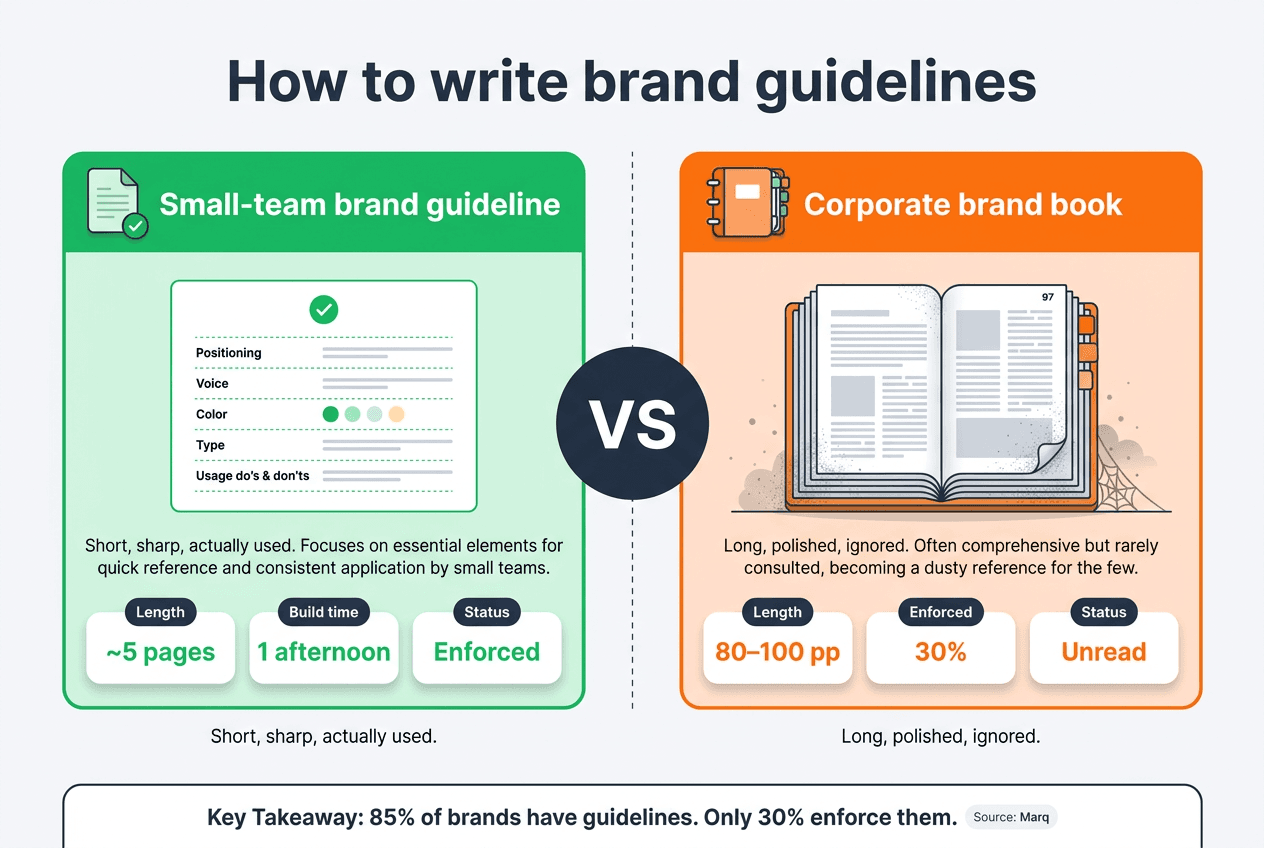
Here's the uncomfortable math behind brand guidelines: 85% of organizations have them, and only 30% enforce them consistently (Marq, formerly Lucidpress). The other 55% wrote a document, saved it to a shared drive, and never looked at it again. The doc exists. The brand still drifts.
For a small team, that gap stings more than it does at a big company. When one in-house marketer — or one agency owner — produces across every channel, there's no brand police down the hall to catch a wrong shade of blue or a value prop that contradicts last week's. And now that 81% of marketing teams use generative AI (CMI/MarketingProfs, 2024), off-brand content gets produced faster than any human can review it.
So the goal isn't a beautiful 90-page brand book. It's a short, sharp document your team will actually open — and, better, rules the work follows on its own. This guide walks the step-by-step process: what to write, in what order, at what scope, and how to keep it from dying in a folder.
Key takeaways
- 85% of organizations have brand guidelines, but only 30% enforce them consistently (Marq, formerly Lucidpress). The failure is enforcement, not authoring.
- Write in order — positioning → voice → visual identity → messaging → usage rules → examples. Most teams start with logos and never write the positioning, which is backwards.
- Keep it to about one screen to five pages. For a small team, the 80-page corporate brand book is the format most likely to go unread.
- Consistent brand presentation is credited with revenue growth by 68% of companies, with reported uplift of 10–20% on average (Lucidpress/Marq). The doc only earns that if it's applied to every output.
How do you write brand guidelines?
Write brand guidelines in a fixed order, foundation first: positioning and mission, then voice, then visual identity, then messaging, then usage rules, then examples — and finish by deciding how they get enforced. Consistent brand presentation is credited with 10–20% more revenue growth on average, and up to 33% at the high end (Lucidpress/Marq; PR Newswire, 2019). That upside only shows up when the guidelines are actually followed.
Here's the process, in the order that works:
- Write the positioning and mission first. Who you're for, what you stand against, the one sentence a stranger should repeat.
- Define the voice and tone. How the brand sounds, with a few do/don't pairs. (Depth lives in the brand voice guidelines — keep it tight here.)
- Lock the visual identity essentials. Logo, color palette with hex codes, two typefaces, basic spacing.
- Set the core messaging. Value proposition, a 50-word boilerplate, three proof points.
- Write the usage rules. The do's and don'ts that keep people from breaking the brand.
- Add real examples. On-brand and off-brand, side by side, so the abstract becomes obvious.
- Decide how it gets enforced. The step everyone skips — and the only one that closes the gap above.
Steps one through six are authoring. Step seven is the whole game. A document that describes the brand but never touches the work is a museum piece. We'll come back to enforcement at the end, because it's where most of this effort either pays off or evaporates. For the fuller field-by-field structure behind each step, the brand blueprint template lays out the framework this process fills in.
What should brand guidelines include?
Brand guidelines for a small team need six sections, no more: positioning and mission, voice and tone, visual identity, core messaging, usage rules, and worked examples. 68% of companies say brand consistency has contributed to revenue growth (Lucidpress/Marq) — and those six sections are what consistency is actually made of. Everything past them is corporate ballast.
Here's what each section carries, and where to stop:
- Positioning and mission. Your ICP, your category, the thing you stand against, your mission in one line. This is strategy, and it anchors every other section.
- Voice and tone. Three or four adjectives, a short do/don't list, one rewritten example. Don't over-build it here — the brand voice guidelines spoke goes deep on voice; this section just points at it.
- Visual identity. Logo files and clear-space, the color palette with hex values, primary and secondary typefaces, and a note on imagery. This is the "brand style guide" most people picture.
- Core messaging. The value proposition, an approved 50-word boilerplate, three proof points, and your tagline if you have one.
- Usage rules. The do's and don'ts. What never to do to the logo. Words you do and don't use. The off-brand patterns to avoid.
- Examples. Real assets, annotated. Nothing teaches a brand faster than "this is right, this is wrong, here's why."
Notice what's missing: brand-history essays, founder mythology, 12 pages of color theory. A large enterprise can afford those. A team of one can't, and shouldn't try.
How long should brand guidelines be?
For a small team, brand guidelines should run about one screen to five pages — not the 80-to-100-page brand book a large enterprise ships. Only 30% of organizations enforce their guidelines consistently (Marq, formerly Lucidpress), and the unenforced ones are almost always the long ones. Length and adoption move in opposite directions.
Think about who reads this. A teammate drafting a LinkedIn post on a Tuesday isn't going to scroll 90 pages to check the tone. A freelancer you've hired for a launch won't read your brand's origin story before designing an ad. The document competes with the deadline, and the deadline wins every time the doc is long.
So write the shortest version that still answers the real questions: How do we sound? What are the colors? What's the value prop? What should I never do? If a section doesn't change what someone makes, cut it. Below is the scope we'd hand a small team — roughly a page per area, with visual identity earning the most room.
This is a team-of-one constraint as much as a brand one. The same logic that makes a marketing team of one productive — fewer tools, tighter loops, less to maintain — applies to the brand doc itself. A short guideline gets updated. A long one rots.
The small-team brand guidelines checklist
Use this as the spec for your first draft. It's the scope we'd hand a small marketing team starting from a blank page — every line earns its place, and nothing here is filler. With generative AI now producing first drafts faster than any reviewer can keep up, a tight checklist is what keeps the volume on-brand instead of just on-time.
The checklist — what every small-team brand guideline needs:
- Positioning: ICP in one sentence, category, what you stand against
- Mission: one line, repeatable by a stranger
- Voice: 3–4 adjectives + a do/don't pair (link out for depth)
- Logo: files, clear-space rule, one "never do this"
- Color: full palette with hex codes, primary vs accent
- Type: two typefaces, when to use each
- Value proposition: the core promise in one sentence
- Boilerplate: an approved ~50-word "about" paragraph
- Proof points: three, with numbers where you have them
- Usage rules: five do's, five don'ts
- Examples: at least one on-brand and one off-brand, annotated
- Enforcement: where these rules live so they're actually applied
If you can fill every line, you have a working brand guideline. If a line stays blank, that's your next decision to make — not a reason to delay shipping the rest. Done and applied beats perfect and ignored.
What does a good brand guidelines example look like?
The best brand guidelines examples are shorter and more opinionated than people expect. Even among the 85% of organizations with guidelines, the ones that get used share a trait (Marq, formerly Lucidpress): they're built for retrieval, not for reading cover to cover. You can scan one and find the answer in seconds.
Look at the public guidelines big brands publish — companies like Mailchimp, Spotify, and Atlassian keep theirs online. Study the structure, not the length. You'll notice the same pattern every time: a clear voice section with concrete examples, a tight visual system, and usage rules written as plain do's and don'ts. They lead with how to use the brand, not the history of how it came to be.
Then shrink it. Your version doesn't need a microsite. It needs the same skeleton — voice, visuals, messaging, rules, examples — at a fraction of the page count. Steal the structure; ignore the scale. A two-person agency and a 2,000-person company need the same sections; they just need very different lengths.
Why do brand guidelines die in a folder — and how do you keep them alive?
Brand guidelines die because authoring and enforcement are two different jobs, and almost everyone only does the first. 85% of organizations have guidelines; 30% enforce them (Marq, formerly Lucidpress). The document isn't the problem. The problem is that a PDF can't review a draft, catch a wrong color, or flag a value prop that contradicts your positioning. It just sits there.
For a big company, enforcement is a team — brand managers, review cycles, approval queues. A small team doesn't have that, and never will. So the small-team fix isn't a longer doc or a stricter process. It's moving the rules from a file nobody opens into the place the work actually happens, so the guideline applies itself to every output instead of waiting to be consulted.
That's the difference between brand guidelines and a brand blueprint. Guidelines describe the brand to a person. A Brand Blueprint stores the same intelligence — positioning, voice, visual rules, messaging, proof — as context an AI marketing system applies automatically, every time it writes a post, drafts an email, or builds a landing page. The doc stops being a reference and becomes a rule the work can't skip. That's how a team of one closes the 55-point gap without hiring a brand cop.
It's also why we built Sivon around the blueprint instead of a static template. You write the brand once; every engine generates against it, so the content sounds like you by default rather than by review. Want to see what that costs versus a brand-guidelines doc nobody enforces? Sivon's pricing lays it out — and the Brand Blueprint is where you'd start.
Frequently asked questions
How do I write brand guidelines from scratch?
Work in order: positioning and mission first, then voice, then visual identity, then messaging, then usage rules, then real examples. Finish by deciding how they're enforced. Since only 30% of organizations consistently enforce their guidelines (Marq), the enforcement step is the one that determines whether any of the writing mattered.
What should brand guidelines include?
Six sections: positioning and mission, voice and tone, visual identity (logo, color, type), core messaging and boilerplate, usage do's and don'ts, and worked examples. Skip the corporate filler. Keep each to about a page — brand consistency is credited with revenue growth by 68% of companies (Lucidpress/Marq), and that comes from clarity, not page count.
How long should brand guidelines be?
About one screen to five pages for a small team — not the 80-to-100-page brand book a large enterprise ships. Length is the enemy of enforcement: 85% of organizations have guidelines but only 30% enforce them (Marq). The unenforced docs are almost always the long ones nobody opens.
What's the difference between brand guidelines and a brand blueprint?
Brand guidelines are a static document a person reads. A brand blueprint is the same intelligence stored as rules a system applies to every output automatically. Guidelines tell someone what to do; a blueprint makes the rules enforce themselves — which closes the roughly 70% enforcement gap most teams never solve on their own.
Are brand guidelines the same as a brand style guide?
Nearly, with a scope difference. A brand style guide usually covers the visual and verbal mechanics — logo, color, type, voice. Brand guidelines wrap that in strategy: positioning, mission, messaging, and rules. For a small team, write one document that covers both rather than splitting it into two files you'll have to maintain separately.
The bottom line
Writing brand guidelines isn't the hard part. You can draft a workable version in an afternoon: positioning, voice, visuals, messaging, rules, examples — in that order, at about five pages, using the checklist above. The hard part is the 55-point gap between the 85% who have guidelines and the 30% who enforce them (Marq, formerly Lucidpress).
A small team can't close that gap with a longer document or a review committee. It closes it by changing what the guideline is — from a file you consult to a brand blueprint the work runs against. Write the doc this week. Then make it the thing your content can't ignore.