Brand Blueprint Template: The 6-Part Framework You Can Fill In Today
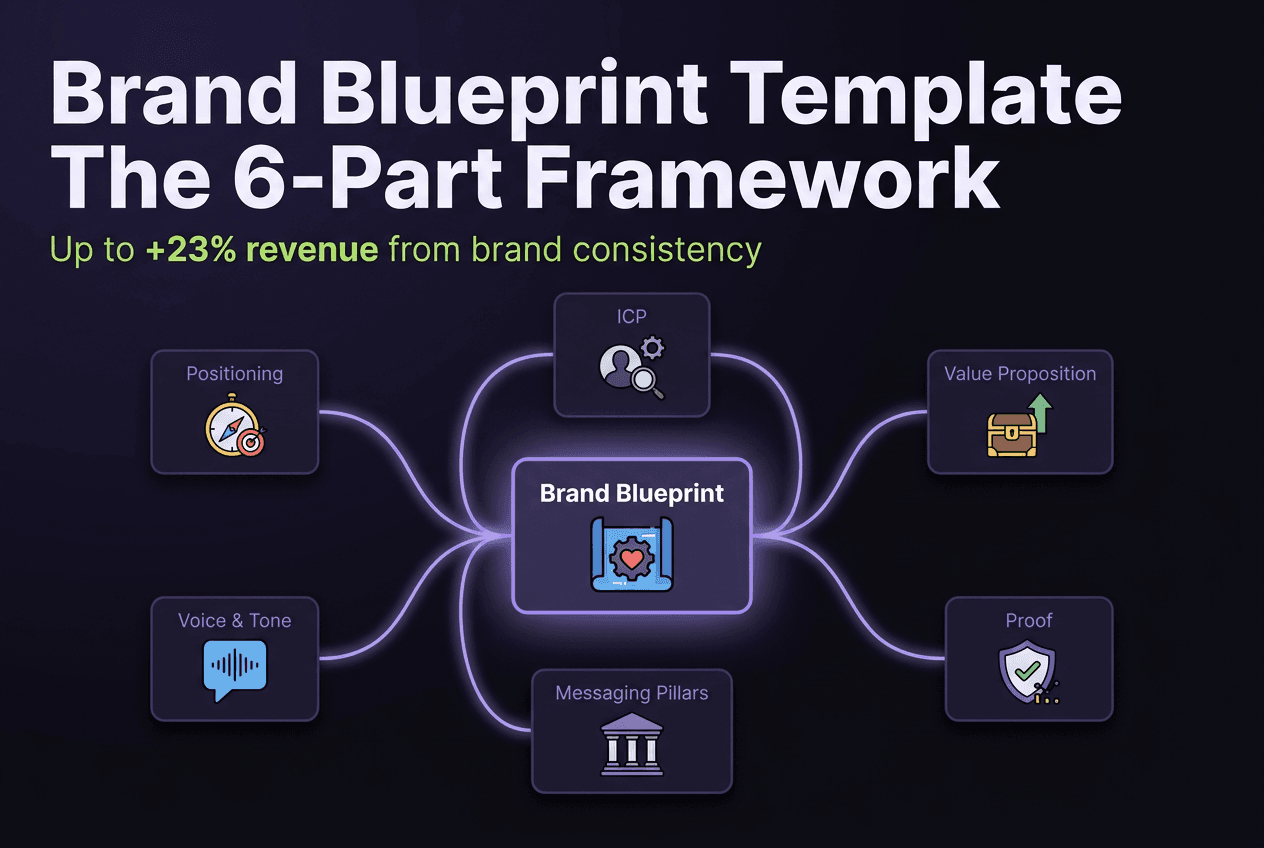
A copy-ready brand blueprint template: positioning, ICP, voice, and proof in six sections, plus the prompts to fill each one in today.

Most brand templates fail the same way. They get filled in once, saved to a shared drive, and never opened again. The logo's in there. The mission statement's in there. And every blog post, email, and LinkedIn update the team ships still reads like it could belong to any competitor in the category.
That isn't a discipline problem. It's a format problem. A brand strategy that lives in a slide deck can't apply itself to the post you're writing at 4pm on a Tuesday.
This is the template that fixes that — six sections you can fill in today, with an example prompt under each one. It's deliberately short. A brand blueprint that fits on a few pages gets used; a 40-page brand bible doesn't. At the end, I'll show how the same six inputs become a living blueprint that every AI output draws from automatically, instead of a document you keep meaning to reference.
Key Takeaways
- A brand blueprint is the strategy layer beneath your guidelines: positioning, ICP, value proposition, voice, messaging pillars, and proof — six sections, one page each.
- Consistent brand presentation can lift revenue by up to 23% (Marq, State of Brand Consistency), yet only 15% of brand assets are actually distinctive (Ipsos & JKR, 2025).
- The template is the easy part. 75% of marketers have adopted AI, but most still ship "one-way, generic" campaigns (Salesforce, 2026) — because the document never reaches the output.
- Copy the six-section framework below, fill it with the prompts provided, then keep it applied to every channel — not parked in a drive.
What is a brand blueprint?
A brand blueprint is a single document that captures the decisions every piece of marketing depends on — positioning, ICP, value proposition, voice, messaging pillars, and proof. It's the reason 75% of marketers can adopt AI yet still send "one-way, generic" campaigns (Salesforce, 2026): the tools work, but they're working without context.
Think of it as the layer beneath your visual guidelines. Guidelines tell a designer which blue to use. A blueprint tells the writer what you stand for, who you're talking to, and why they should care. One governs how you look. The other governs what you mean.
For a small team, that distinction is the whole game. When one or two people run all of marketing, there's no brand manager reviewing every asset before it goes out. The blueprint is the reviewer. It's the shared reference that lets a founder, a contractor, and an AI tool all produce work that sounds like the same company.
If you want the execution layer — logo lockups, color, type — that's a separate document. We cover it in how to write brand guidelines. This piece is about the strategy that comes first.
The brand blueprint template: 6 sections to copy
Only 15% of brand assets tested across 523 brands reached "gold standard" distinctiveness — logos hit 19%, slogans just 6%, color a dismal 4% (Ipsos & JKR, 2025, n=26,000+). Brands blur together because the decisions that make them distinct were never written down. This template writes them down.
Here's the whole template at a glance. Copy this table, then work through the six sections below — each one has fields to fill and a prompt to draft it fast.
| # | Section | What it answers | What to fill in |
|---|---|---|---|
| 01 | Positioning | What category are we in, and why are we different? | One positioning statement + your single sharpest differentiator |
| 02 | ICP | Who is this for — and who is it not for? | Role, company size, the trigger to look, what they're switching from, one disqualifier |
| 03 | Value proposition | What's the core promise? | The before → after, the time-to-value, the one outcome you own |
| 04 | Voice & tone | How do we sound? | Three adjectives, a "we say / we don't say" list, banned words, reading level |
| 05 | Messaging pillars | What three or four things do we repeat everywhere? | 3–4 pillars, each with a claim + the proof behind it |
| 06 | Proof | Why should anyone believe us? | Results, customer quotes, logos, credentials, demos |
01. Positioning
Positioning is the category you compete in and the one reason you win inside it. Write it as a single sentence so it's impossible to hide behind adjectives. The format that forces clarity: For [ICP] who [problem], [brand] is the [category] that [unique benefit], unlike [main alternative].
If you can't finish that sentence without reaching for the deck, that's the work — no amount of content fixes fuzzy positioning.
Prompt: "Write a one-sentence positioning statement for [product] in the format: For [ICP] who [problem], [brand] is the [category] that [benefit], unlike [main alternative]. Then give two sharper alternatives for the differentiator."
02. ICP (Ideal Customer Profile)
Your ICP defines who the brand is for — and, just as importantly, who it isn't. A vague ICP is why so much content reads as generic: it's written for everyone, so it lands with no one. Be specific enough that a stranger could disqualify a bad-fit lead from your description alone.
Capture the role or title, company size, the trigger that makes them start looking, the alternative they're switching from, and at least one disqualifier.
Prompt: "Draft a five-line ICP for [product]: role/title, company size, the trigger that makes them look, the alternative they're switching from, and one disqualifier that means they're not a fit."
03. Value proposition
The value proposition is the core promise — the outcome you own that competitors can't claim as cleanly. Skip the feature list. State the before (the painful status quo), the after (life with you), and the bridge between them, including how fast the customer feels it.
A strong value prop survives being read out loud to a skeptical buyer. A weak one needs a slide to explain.
Prompt: "Write a value proposition for [ICP] using the before–after–bridge frame in three sentences. The 'after' must name one specific outcome, not a category of benefit."
04. Voice & tone
Voice is how the brand sounds when it speaks — and it's the section AI gets wrong most often, because "professional and friendly" describes ten thousand companies. Pin it down. Three adjectives, a short "we say / we don't say" list, a few banned words, and a target reading level give any writer (human or AI) something to match.
This section deserves its own depth. We expand it — with example voice charts and a full do/don't framework — in brand voice guidelines.
Prompt: "Define a brand voice for [product] in three adjectives. Then build a 'we say / we don't say' table with five rows, and list five words we never use."
05. Messaging pillars
Messaging pillars are the three or four themes you repeat across every channel until the market associates them with you. Each pillar pairs a claim with the proof that makes it credible and, ideally, the objection it quietly answers.
Pillars are what keep a year of content on-message without a content calendar doing the heavy lifting. They're the reason your blog, your ads, and your sales deck reinforce instead of contradict.
Prompt: "Give me three messaging pillars for [product]. For each: a one-line claim, the single proof point behind it, and the customer objection it answers."
06. Proof
Proof is the answer to the only question a skeptical buyer is actually asking: why should I believe you? Group it into three buckets — quantitative results (metrics, benchmarks), social proof (quotes, logos, case studies), and credibility markers (credentials, press, certifications, a live demo).
Most teams have more proof than they think. The blueprint just collects it in one place so it stops getting reinvented for every landing page.
Prompt: "List the proof assets for [product] grouped into: quantitative results, social proof, and credibility markers. Flag the three strongest for above-the-fold use."
The part everyone skips: A filled-in template isn't the asset — the application is. The blueprint creates value only on the days it touches an output. A perfect six-section document that lives in Google Drive while the team prompts a blank chatbot is worth exactly nothing. That gap, not the writing, is where brands lose their voice.
Brand blueprint vs brand guidelines
A brand blueprint governs strategy; brand guidelines govern execution. The blueprint answers who we're for, what we claim, why we're different. Guidelines answer which logo, which hex code, how much padding. You need both — but in order. Strategy first, then the rules that protect it.
The confusion costs real money. Consistent brand presentation can raise revenue by up to 23% (Marq, State of Brand Consistency), but presentation without strategy just makes generic content look tidy. A polished, on-brand post that says nothing distinctive is still forgettable — which is how 77% of B2B buyers end up calling their last purchase "complex or difficult," unable to tell suppliers apart (Gartner).
So which do you build first? If you can't state your positioning and ICP in two sentences, start with the blueprint above. If those are sharp but your assets look scattered, you need brand guidelines and a tightened voice section. Most small teams are missing the strategy layer, not the style guide.
How to turn a static template into a living Brand Blueprint
The hard problem isn't drafting the template — it's keeping it applied. Marketers using generative AI save more than five hours a week on content (McKinsey, 2024), but those hours leak right back out when every draft starts from a blank prompt that knows nothing about your positioning, ICP, or voice. You re-paste the context, or you skip it and edit generic output into shape. Either way, the tax compounds.
This is the problem Sivon was built around. Instead of a document you remember to reference, the six sections above become a Brand Blueprint — persistent business context that every output draws from automatically. Write a blog post, a LinkedIn update, a cold email, and the positioning, ICP, voice, and proof are already in the room. Nothing comes out generic because nothing starts from blank.
What we see: The difference isn't drafting speed — both a blank prompt and a context-aware one return copy in seconds. It's the editing distance. Output generated from a stored blueprint needs a light pass to sound like the brand; output from a blank prompt needs a rewrite. Across a week of content, that's the gap between shipping and stalling.
That's the same principle behind setting brand context once and applying it across channels, which we walk through in content marketing automation. And it's the operating model that makes a marketing team of one viable: the system carries the context, so one person can sound like a full department. You can see how the system works end to end, or compare plans on pricing.
Start with the template, then make it live
Copy the six-section framework, fill each part with the prompts above, and you'll have a brand blueprint today — sharper than most companies with a brand team ever bother to write down. That's the easy 20% of the value.
The other 80% is application: getting positioning, ICP, voice, and proof into every output, every week, without re-explaining your business to a tool that forgets. A static template can't do that. A living one can.
Build the document first. Then decide whether you want to keep applying it by hand — or let the system carry it for you.